
Western1788–1860
Schopenhauer
Germany
Philosopher of the Will, whose pessimism and aesthetics deeply influenced later thought.
Biography
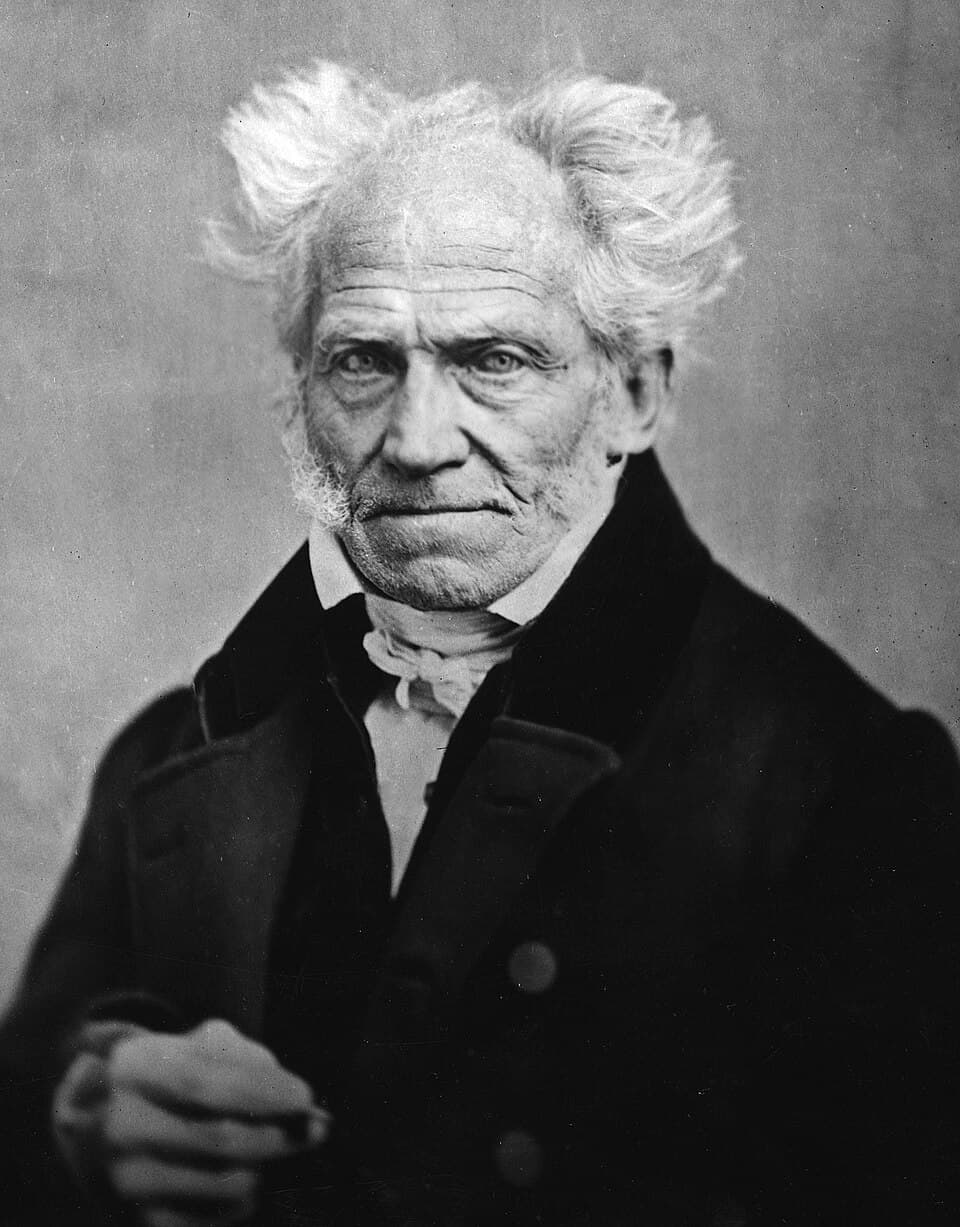
Arthur Schopenhauer published his masterpiece at thirty and waited thirty years for anyone to notice. The World as Will and Representation (1818) begins from Kant — the world we know is representation, appearance — and then names the thing-in-itself Kant had declared unknowable: Will. Blind, aimless striving underlies everything: gravity, growth, hunger, lust, ambition. The intellect is the Will's servant, consciousness its instrument; and because willing is lack, and lack is pain, existence oscillates between suffering and boredom. "Life is a pendulum," he wrote, "swinging between pain and ennui."
He was the first major European philosopher to build with Eastern materials. The Upanishads — his nightly reading, "the consolation of my life" — and Buddhism confirmed his diagnosis: the world is maya, craving is suffering, and salvation lies in the will's self-denial. His ethics rests not on Kantian duty but on compassion (Mitleid): in suffering-with, the illusory boundary between selves thins, disclosing the metaphysical unity of all beings. His soteriology is aesthetic and ascetic: art — music above all, a direct copy of the Will itself — grants momentary release; the saint's renunciation grants the lasting kind.
Of the God of theism he was witheringly dismissive — optimism he called "a truly wicked way of thinking, a bitter mockery of the unspeakable sufferings of humanity" — yet he took religion more seriously than the optimistic deists did, reading Christianity's pessimistic core (the Fall, the cross, contempt of the world) as mythic truth about the Will.
Fame arrived after 1851 with the aphoristic Parerga and Paralipomena. Wagner set him to music; Nietzsche began as his disciple and built by breaking with him; Freud's unconscious and the twentieth century's dark anthropology are unthinkable without the grumpy sage of Frankfurt and his poodle.
Works


On the Fourfold Root of the Principle of Sufficient Reason, and On the Will in Nature: Two Essays (revised edition)
en
Sufficient reason; Will












The World as Will and Idea (Vol. 1 of 3)
en
Idea (Philosophy); Knowledge, Theory of; Philosophy; Will

The World as Will and Idea (Vol. 2 of 3)
en
Idea (Philosophy); Knowledge, Theory of; Philosophy; Will

The World as Will and Idea (Vol. 3 of 3)
en
Idea (Philosophy); Knowledge, Theory of; Philosophy; Will
Quote Attribution
Identify the philosopher behind a quote using AI.
Books by & about Schopenhauer
Works by and about Schopenhauer — readable in full, right here in the Library.
Read on site →

Read on site →
Read on site →
Read on site →
Read on site →

Read on site →

Read on site →
Read on site →
Read on site →
Read on site →

Read on site →
Read on site →
Read on site →
Read on site →

Read on site →
Read on site →
Read on site →

Read on site →

Read on site →

Read on site →

Read on site →

Read on site →
Read on site →
Read on site →