John Shaqi
Western1632–1677

Baruch Spinoza

Amsterdam

Dutch rationalist who identified God with Nature and grounded ethics in geometric reasoning.
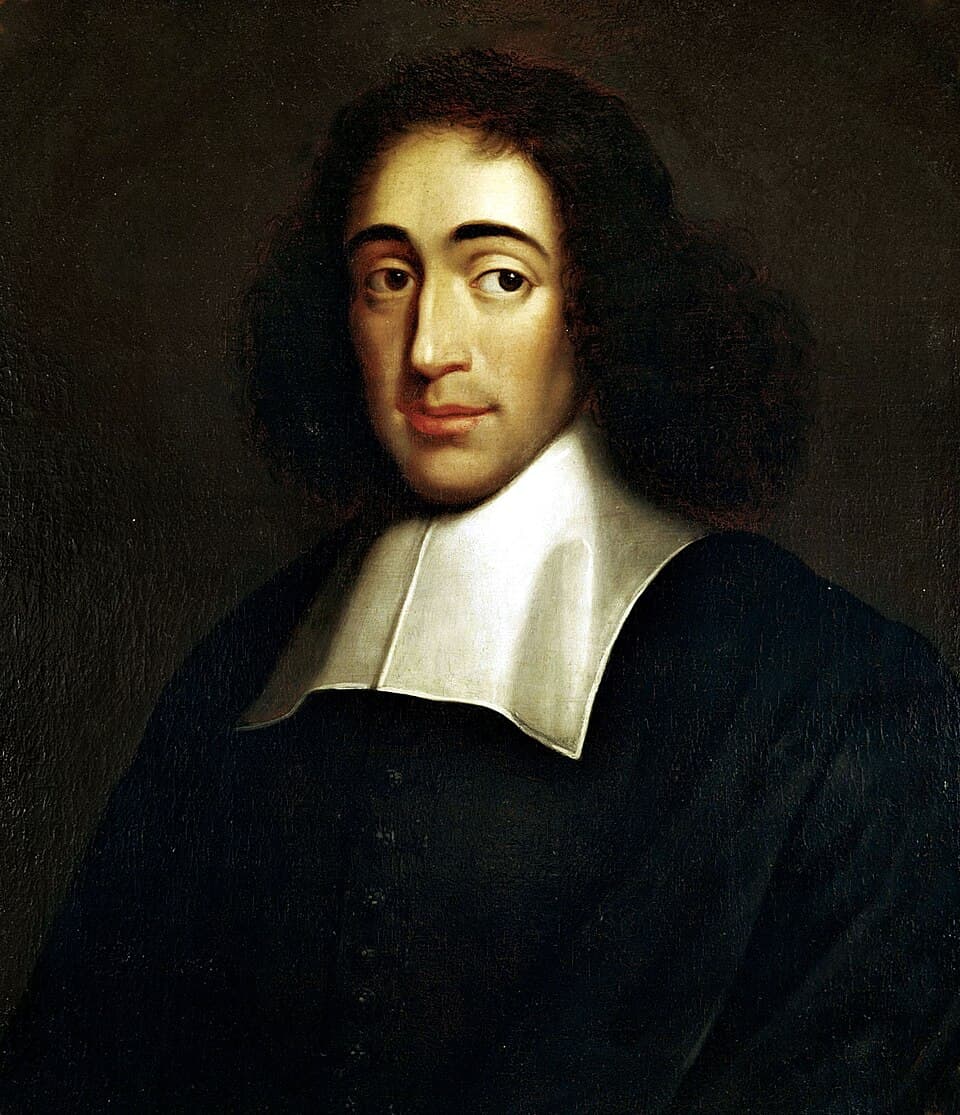
Baruch Spinoza
Anonymous · Public domain · Wikimedia Commons

Biography

Baruch Spinoza was expelled from Amsterdam's Portuguese-Jewish community at twenty-three with a herem of unusual violence — cursed by day and by night, none permitted to come within four cubits of him — and never asked to return. He ground lenses for a living, declined a Heidelberg professorship to keep his independence, and died at forty-four leaving the Ethics in a desk drawer.

The Ethics (1677), written in the austere style of Euclid — definitions, axioms, propositions — argues that there is exactly one substance: God, or Nature (Deus sive Natura). Everything that exists is a mode of this one infinite substance; mind and body are the same reality under two attributes; nothing is contingent; free will is the dream of a stone in flight thinking it chose its arc. God, in Spinoza, does not plan, judge, love, or answer prayers — divine anthropomorphism is the projection of human hope onto necessity. Blessedness is the intellectual love of God: understanding necessity so thoroughly that the passions loosen their grip.

The Theological-Political Treatise (1670), published anonymously and promptly banned, founded modern biblical criticism: scripture is to be read like any ancient text, by history and philology; prophets excelled in imagination, not knowledge; miracles are events whose natural causes we ignore; and the state should tolerate all opinions since belief cannot be coerced.

For a century "Spinozist" meant "atheist" — Hume slyly called his view the "hideous hypothesis" — while Novalis called him "the God-intoxicated man." Both were pointing at the same thing: a piety without a person behind the curtain. Einstein, asked if he believed in God, answered: Spinoza's God. He remains the purest case of the pantheist alternative — the sharpest test of whether "God" can survive the loss of personality.

Works

A Theological-Political Treatise [Part III]Baruch Spinoza
A Theological-Political Treatise [Part III]

A Theological-Political Treatise [Part III]

en

Free thought -- Early works to 1800; Philosophy and religion -- Early works to 1800; Political science -- Early works to 1800


A Theological-Political Treatise [Part IV]Baruch Spinoza
A Theological-Political Treatise [Part IV]

A Theological-Political Treatise [Part IV]

en

Free thought -- Early works to 1800; Philosophy and religion -- Early works to 1800; Political science -- Early works to 1800

EthicsBaruch Spinoza
Ethics

Ethics

en

Ethics

Ethics — Part 1Baruch Spinoza
Ethics — Part 1

Ethics — Part 1

en

Ethics

Ethics — Part 2Baruch Spinoza
Ethics — Part 2

Ethics — Part 2

en

Ethics

Ethics — Part 3Baruch Spinoza
Ethics — Part 3

Ethics — Part 3

en

Ethics

Ethics — Part 4Baruch Spinoza
Ethics — Part 4

Ethics — Part 4

en

Ethics

Ethics — Part 5Baruch Spinoza
Ethics — Part 5

Ethics — Part 5

en

Ethics

On the Improvement of the UnderstandingBaruch Spinoza
On the Improvement of the Understanding

On the Improvement of the Understanding

en

Free thought; Philosophy and religion

The Philosophy of SpinozaBaruch Spinoza
The Philosophy of Spinoza

The Philosophy of Spinoza

en

Philosophy

Theologico-Political Treatise — Part 1Baruch Spinoza
Theologico-Political Treatise — Part 1

Theologico-Political Treatise — Part 1

en

Free thought -- Early works to 1800; Philosophy and religion -- Early works to 1800; Political science -- Early works to 1800

Theologico-Political Treatise — Part 2Baruch Spinoza
Theologico-Political Treatise — Part 2

Theologico-Political Treatise — Part 2

en

Free thought -- Early works to 1800; Philosophy and religion -- Early works to 1800; Political science -- Early works to 1800

Quote Attribution

Identify the philosopher behind a quote using AI.

Books by & about Baruch Spinoza

Works by and about Baruch Spinoza — readable in full, right here in the Library.
A Discourse of a Method for the Well Guiding of Reason: and the Discovery of Truth in the SciencesDescartes, René

A Discourse of a Method for the Well Guiding of Reason: and the Discovery of Truth in the Sciences

Descartes, René

Read on site →
A System of Logic, Ratiocinative and InductiveMill, John Stuart
A System of Logic, Ratiocinative and Inductive

A System of Logic, Ratiocinative and Inductive

Mill, John Stuart

Read on site →
A Theological-Political Treatise [Part III]Spinoza, Benedictus de

A Theological-Political Treatise [Part III]

Spinoza, Benedictus de

Read on site →
A Theological-Political Treatise [Part IV]Spinoza, Benedictus de

A Theological-Political Treatise [Part IV]

Spinoza, Benedictus de

Read on site →
A Treatise of Human Nature: Being an Attempt to Introduce the Experimental Method Into Moral Subjects; and Dialogues Concerning Natural ReligionHume, David
A Treatise of Human Nature: Being an Attempt to Introduce the Experimental Method Into Moral Subjects; and Dialogues Concerning Natural Religion

A Treatise of Human Nature: Being an Attempt to Introduce the Experimental Method Into Moral Subjects; and Dialogues Concerning Natural Religion

Hume, David

Read on site →
Alice in Wonderland: A Dramatization of Lewis Carroll's "Alice's Adventures in Wonderland" and "Through the Looking Glass"Carroll, Lewis
Alice in Wonderland: A Dramatization of Lewis Carroll's "Alice's Adventures in Wonderland" and "Through the Looking Glass"

Alice in Wonderland: A Dramatization of Lewis Carroll's "Alice's Adventures in Wonderland" and "Through the Looking Glass"

Carroll, Lewis

Read on site →
Alice's Adventures in WonderlandCarroll, Lewis
Alice's Adventures in Wonderland

Alice's Adventures in Wonderland

Carroll, Lewis

Read on site →
An Enquiry Concerning Human UnderstandingHume, David
An Enquiry Concerning Human Understanding

An Enquiry Concerning Human Understanding

Hume, David

Read on site →
An Enquiry Concerning the Principles of MoralsHume, David
An Enquiry Concerning the Principles of Morals

An Enquiry Concerning the Principles of Morals

Hume, David

Read on site →
Analysis of the Phenomena of the Human MindMill, James
Analysis of the Phenomena of the Human Mind

Analysis of the Phenomena of the Human Mind

Mill, James

Read on site →
AnthemRand, Ayn
Anthem

Anthem

Rand, Ayn

Read on site →
ApologyPlato
Apology

Apology

Plato

Read on site →
Apology, Crito, and Phaedo of SocratesPlato

Apology, Crito, and Phaedo of Socrates

Plato

Read on site →
Aristotle on the art of poetryAristotle
Aristotle on the art of poetry

Aristotle on the art of poetry

Aristotle

Read on site →
Aristotle's History of Animals: In Ten BooksAristotle
Aristotle's History of Animals: In Ten Books

Aristotle's History of Animals: In Ten Books

Aristotle

Read on site →
Aristotle's works:: Containing the Master-piece, Directions for Midwives, and Counsel and Advice to Child-bearing Women with Various Useful RemediesAristotle, pseud.

Aristotle's works:: Containing the Master-piece, Directions for Midwives, and Counsel and Advice to Child-bearing Women with Various Useful Remedies

Aristotle, pseud.

Read on site →
Auguste Comte and PositivismMill, John Stuart
Auguste Comte and Positivism

Auguste Comte and Positivism

Mill, John Stuart

Read on site →
AutobiographyMill, John Stuart
Autobiography

Autobiography

Mill, John Stuart

Read on site →
Beyond Good and EvilNietzsche, Friedrich Wilhelm
Beyond Good and Evil

Beyond Good and Evil

Nietzsche, Friedrich Wilhelm

Read on site →
CandideVoltaire
Candide

Candide

Voltaire

Read on site →
CharmidesPlato
Charmides

Charmides

Plato

Read on site →
Considerations on Representative GovernmentMill, John Stuart
Considerations on Representative Government

Considerations on Representative Government

Mill, John Stuart

Read on site →
CratylusPlato
Cratylus

Cratylus

Plato

Read on site →
CritiasPlato
Critias

Critias

Plato

Read on site →