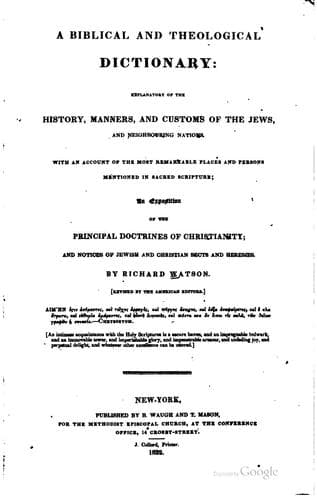
A Biblical and Theological Dictionary: explanatory of the history, manners, and customs of the Jews, and neighbouring nations — John Shaqi
A Biblical and Theological Dictionary: explanatory of the history, manners, and customs of the Jews, and neighbouring nationsWatson, Richard
Religion
A Biblical and Theological Dictionary: explanatory of the history, manners, and customs of the Jews, and neighbouring nations
Watson, Richard
Bible -- Dictionaries; Theology -- Dictionaries
“Abel,” Dr. Magee justly says, “in firm reliance on the promise of God,
and in obedience to his command, offered that sacrifice which had been
enjoined as the religious expression of his faith; whilst Cain,
disregarding the gracious assurances that had been vouchsafed, or at
least disdaining to adopt the prescribed mode of manifesting his belief,
possibly as not appearing to _his reason_ to possess any efficacy or
natural fitness, thought he had sufficiently acquitted himself of his
duty in acknowledging the general superintendence of God, and expressing
his gratitude to the Supreme Benefactor, by presenting some of those
good things which he thereby confessed to have been derived from his
bounty. In short, Cain, the first-born of the fall, exhibits the first
fruits of his parents’ disobedience, in the arrogance and
self-sufficiency of reason rejecting the aids of revelation, because
they fell not within its apprehension of right. He takes the first place
in the annals of Deism, and displays, in his proud rejection of the
ordinance of sacrifice, the same spirit which, in later days, has
actuated his _enlightened_ followers, in rejecting the sacrifice of
Christ.”
Abel was killed about the year of the world, 130.
ABEL-MISRAIM, the floor of Atad, beyond the river Jordan, where Joseph,
his brethren, and the Egyptians mourned for the death of Jacob, Gen. l,
11. On this occasion the funeral procession was, at the command of
Joseph, attended by “all the elders of Egypt, and all the servants of
Pharaoh, and all his house, and the house of his brethren, chariots and
horsemen, a very great company;” an affecting proof, as it has been
remarked, of Joseph’s simplicity and singleness of heart, which allowed
him to give to the great men of Egypt, over whom he bore absolute rule,
an opportunity of observing his own comparatively humble origin, by
leading them in attendance upon his father’s corpse to the valleys of
Canaan, the modest cradle of his race, and to their simple burial
places.
ABEL-SHITTIM, a city situate in the plains of Moab, beyond Jordan,
opposite to Jericho, Num. xxv, 1, &c; xxiii, 49; Joshua xi, 1. Eusebius
says it stood in the neighbourhood of mount Peor. Moses encamped at
Abel-Shittim some time before the Hebrew army passed the Jordan. Here
the Israelites fell into idolatry, and worshipped Baal-peor, for which
God punished them by the destruction of twenty-four thousand persons in
one day.
ABIAH, the second son of the prophet Samuel, and brother of Joel. Samuel
having entrusted to his sons the administration of public justice, and
admitted them to a share in the government, they behaved so ill, that
the people demanded a king, 1 Sam. viii, 2. A. M. 2909.
Public-domain text, read in full here on John Shaqi.
Reviews
Reviews
No reviews yet
Be the first to share your thoughts on this work.
Join the Discussion
Join the discussion
Sign in to leave a comment or review.
Sign InorCreate an account