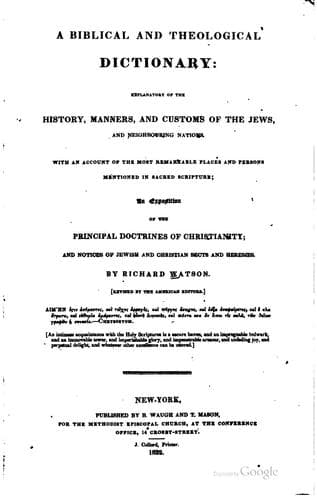
A Biblical and Theological Dictionary: explanatory of the history, manners, and customs of the Jews, and neighbouring nationsWatson, Richard
Religion
A Biblical and Theological Dictionary: explanatory of the history, manners, and customs of the Jews, and neighbouring nations
Watson, Richard
Bible -- Dictionaries; Theology -- Dictionaries
ABIATHAR, the son of Ahimelech, and the tenth high priest among the
Jews, and fourth in descent from Eli, 2 Sam. viii, 17; 1 Chron. xviii,
16. When Saul sent to Nob to murder all the priests, Abiathar escaped
the massacre, and fled to David in the wilderness. There he continued in
the quality of high priest; but Saul, out of aversion to Ahimelech, whom
he imagined to have betrayed his interests, transferred the dignity of
the high priesthood from Ithamar’s family into that of Eleazar, by
conferring this office upon Zadok. Thus there were, at the same time,
two high priests in Israel, Abiathar with David, and Zadok with Saul. In
this state things continued, until the reign of Solomon, when Abiathar,
being attached to the party of Adonijah, was, by Solomon, divested of
his priesthood, A. M. 2989; and the race of Zadok alone performed the
functions of that office during the reign of Solomon, to the exclusion
of the family of Ithamar, according to the word of the Lord to Eli, 1
Sam. ii, 30, &c.
ABIB, the name of the first Hebrew sacred month, Exod. xiii, 4. This
month was afterward called Nisan; it contained thirty days, and answered
to part of our March and April. Abib signifies green ears of corn, or
fresh fruits, according to Jerom’s translation, Exod. xiii, 4, and to
the LXX. It was so named because corn, particularly barley, was in ear
at that time. It was an early custom to give names to months, from the
appearances of nature; and the custom is still in force among many
nations. The year among the Jews commenced in September, and
consequently their jubilees and other civil matters were regulated in
this way, Lev. xxv, 8–10; but their sacred year began in Abib. This
change took place at the redemption of Israel from Egypt, Exod. xii, 2,
“This shall be to you the beginning of months.” Ravanelli observes, that
as this deliverance from Egypt was a figure of the redemption of the
church of Jesus Christ, who died and rose again in this month, it was
made the “beginning of months,” to lead the church to expect the
acceptable year of the Lord. On the tenth day of this month the paschal
lamb was taken; and on the fourteenth they ate the passover. On the
seven succeeding days they celebrated the feast of unleavened bread, on
the last of which days they held a solemn convocation, Exod. xii, xiii.
On the fifteenth they gathered the sheaf of the barley first fruits, and
on the following day presented an offering of it to the Lord, which
having done they might begin their harvest, Lev. xxiii.
Public-domain text, read in full here on John Shaqi.
Reviews
Reviews
No reviews yet
Be the first to share your thoughts on this work.
Join the Discussion
Join the discussion
Sign in to leave a comment or review.
Sign InorCreate an account