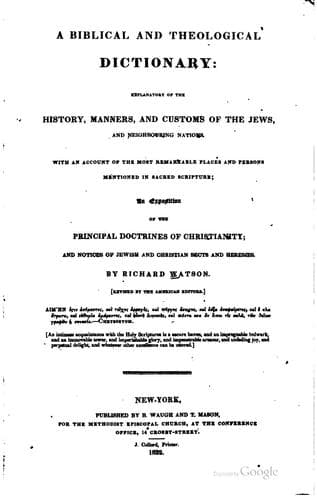
A Biblical and Theological Dictionary: explanatory of the history, manners, and customs of the Jews, and neighbouring nationsWatson, Richard
Religion
A Biblical and Theological Dictionary: explanatory of the history, manners, and customs of the Jews, and neighbouring nations
Watson, Richard
Bible -- Dictionaries; Theology -- Dictionaries
ABIHU, the son of Aaron, the high priest, was consumed, together with
his brother Nadab, by fire sent from God, because he had offered incense
with strange fire, instead of taking it from the altar, Lev. x, 1, 2.
This calamity happened A. M. 2514; within eight days after the
consecration of Aaron and his sons. Some commentators believe that this
fire proceeded from the altar of burnt offerings; others, that it came
from the altar of incense. Several interpreters, as the Rabbins, Lyra,
Cajetan, and others, are of opinion, that Nadab and Abihu were overtaken
with wine, and so forgot to take the sacred fire in their censers. This
conjecture is founded on the command of God delivered immediately
afterward to the priests, forbidding them the use of wine during the
time they should be employed in the service of the temple. Another class
allege, that there was nothing so heinous in their transgression, but it
was awfully punished, to teach ministers fidelity and exactness in
discharging their office. It had a vastly more important meaning,--this
instance of vengeance is a standing example of that divine wrath which
shall consume all who pretend to serve God, except with incense kindled
from the one altar and offering by which he for ever perfects them that
are sanctified.
ABIJAH, the son of Jeroboam, the first king of the ten tribes, who died
very young, 1 Kings xiv, 1, &c, A. M. 3046.--2. The son of Rehoboam,
king of Judah, and of Maachah, the daughter of Uriel, who succeeded his
father, A. M. 3046, 2 Chron. xi, 20; xiii, 2, &c. The Rabbins reproach
this monarch with neglecting to destroy the profane altar which Jeroboam
had erected at Bethel; and with not suppressing the worship of the
golden calves there after his victory over that prince.
ABILENE, a small province in Cœlo Syria, between Lebanon and
Antilibanus. Of this place Lysanias was governor in the fifteenth year
of Tiberius, Luke iii, 1. Abela, or Abila, the capital, was north of
Damascus, and south of Heliopolis.
ABIMELECH. This seems to have been the title of the kings of Philistia,
as Cæsar was of the Roman emperors, and Pharaoh of the sovereigns of
Egypt. It was the name also of one of the sons of Gideon, who became a
judge of Israel, Judges ix; and of the Jewish high priest, who gave
Goliath’s sword, which had been deposited in the tabernacle, and part of
the shew bread, to David, at the time this prince was flying from Saul,
1 Sam. xxi, 1.
Public-domain text, read in full here on John Shaqi.
Reviews
Reviews
No reviews yet
Be the first to share your thoughts on this work.
Join the Discussion
Join the discussion
Sign in to leave a comment or review.
Sign InorCreate an account