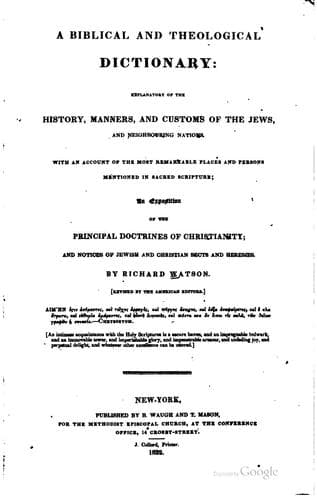
A Biblical and Theological Dictionary: explanatory of the history, manners, and customs of the Jews, and neighbouring nations — John Shaqi
A Biblical and Theological Dictionary: explanatory of the history, manners, and customs of the Jews, and neighbouring nationsWatson, Richard
Religion
A Biblical and Theological Dictionary: explanatory of the history, manners, and customs of the Jews, and neighbouring nations
Watson, Richard
Bible -- Dictionaries; Theology -- Dictionaries
ABIRAM, the eldest son of Hiel, the Bethelite. Joshua having destroyed
the city of Jericho, pronounced this curse: “Cursed be the man, before
the Lord, that riseth up and buildeth this city, Jericho: he shall lay
the foundation thereof in his first-born, and in his youngest son shall
he set up the gates of it,” Joshua vi, 26. Hiel of Bethel, about five
hundred and thirty-seven years after this imprecation, having undertaken
to rebuild Jericho, whilst he was laying the foundation of it, lost his
eldest son, Abiram, 1 Kings xvi, 34; and Segub, the youngest, when they
set up the gates of it: a remarkable instance of a prophetic
denunciation fulfilled, perhaps on a person who would not credit the
tradition, or the truth of the prediction. So true is the word of the
Lord; so minutely are the most distant contingencies foreseen by him;
and so exact is the accomplishment of Divine prophecy!
2. ABIRAM, the son of Eliab, of the tribe of Reuben, was one of those
who conspired with Korah and Dathan against Moses in the wilderness, and
was swallowed up alive, with his companions, by the earth, which opened
to receive them, Num. xvi.
ABISHAG, a young woman, a native of Shunam, in the tribe of Issachar.
David, at the age of seventy, finding no warmth in his bed, was advised
by his physicians to procure some young person, who might communicate
the heat required. To this end Abishag was presented to him, who was one
of the most beautiful women in Israel, 1 Kings i, 3; and the king made
her his wife. After his death, Adonijah requested her in marriage, for
which he lost his life; Solomon perceiving in this a design upon the
crown also. Adonijah was his elder brother, an intriguing man, and had
aspired to be king before the death of David, and had had his life
spared only upon the condition of his peaceable conduct. By this request
he convinced Solomon, that he was still actuated by political views, and
this brought upon him the punishment of treason.
ABISHAI, the son of Zeruiah, David’s sister, who was one of the most
valiant men of his time, and one of the principal generals in David’s
armies.
ABLUTION, purification by washing the body, either in whole or part.
Ablutions appear to be almost as ancient as external worship itself.
Moses enjoined them; the Heathens adopted them; and Mohammed and his
followers have continued them: thus they have been introduced among most
nations, and make a considerable part of all superstitious religions.
The Egyptian priests had their diurnal and nocturnal ablutions; the
Grecians, their sprinklings; the Romans, their lustrations and
lavations; the Jews, their washings of hands and feet, beside their
baptisms; the ancient Christians used ablution before communion, which
the Romish church still retains before the mass, sometimes after; the
Syrians, Copts, &c, have their solemn washings on Good Friday; the Turks
their greater and less ablutions, &c.
Public-domain text, read in full here on John Shaqi.
Reviews
Reviews
No reviews yet
Be the first to share your thoughts on this work.
Join the Discussion
Join the discussion
Sign in to leave a comment or review.
Sign InorCreate an account