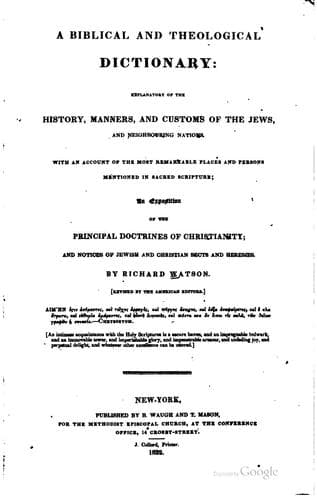
A Biblical and Theological Dictionary: explanatory of the history, manners, and customs of the Jews, and neighbouring nationsWatson, Richard
Religion
A Biblical and Theological Dictionary: explanatory of the history, manners, and customs of the Jews, and neighbouring nations
Watson, Richard
Bible -- Dictionaries; Theology -- Dictionaries
3. Abraham, knowing the dissolute character of the Egyptians, directed
Sarah to call herself his sister, which she was, although by another
mother; fearing that if they knew her to be his wife, they would not
only seize her, but kill him. This circumstance indicates the vicious
state of morals and government in Egypt at this early period. In this
affair Abraham has been blamed for want of faith in God; but it was
perhaps no more than an act of common prudence, as the seraglio of the
Egyptian monarch was supplied by any means, however violent and lawless.
Sarah, upon the report of her beauty, was seized and taken into his
harem; and God sent great plagues upon his house, which, from their
extraordinary character, he concluded to be divine judgments. This led
to inquiry, and on discovering that he was detaining another man’s wife
by violence, he sent her back, and dismissed Abraham laden with
presents.
4. After the famine Abraham returned to Canaan, and pitched his tents
between Bethel and Hai, where he had previously raised an altar. Here,
as his flocks and herds, and those of Lot, had greatly increased, and
strifes had arisen between their herdsmen as to pasturage and water,
they peaceably separated. Lot returning to the plain of the Jordan,
which before the destruction of Sodom was as “the garden of God,” and
Abraham to Mamre, near Hebron, after receiving a renewal of the promise,
that God would give him the whole land for a possession. The separation
of Abraham and Lot still farther secured the unmingled descent of the
Abrahamitic family. The territories of the kings of the cities of the
plain were a few years afterward invaded by a confederacy of the petty
kings of the Euphrates and the neighbouring countries, and Lot and his
family were taken prisoners. This intelligence being brought to Abraham,
he collected the men of his tribe, three hundred and eighteen, and
falling upon the kings by night, near the fountains of Jericho, he
defeated them, retook the spoil, and recovered Lot. On his return,
passing near Salem, supposed to be the city afterward called Jerusalem,
he was blessed by its king Melchizedec, who was priest of the most high
God; so that the knowledge and worship of Jehovah had not quite departed
at that time from the Canaanitish nations. To him Abraham gave a tithe
of the spoil. The rest he generously restored to the king of Sodom,
refusing, in a noble spirit of independence, to retain so much as a
“shoe lachet,” except the portion which, by usage of war, fell to the
young native sheiks, Aner, Eschal, and Mamre, who had joined him in the
expedition.
Public-domain text, read in full here on John Shaqi.
Reviews
Reviews
No reviews yet
Be the first to share your thoughts on this work.
Join the Discussion
Join the discussion
Sign in to leave a comment or review.
Sign InorCreate an account