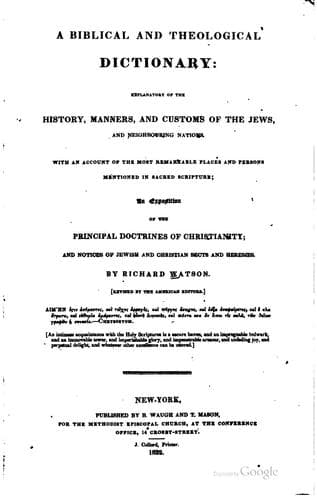
A Biblical and Theological Dictionary: explanatory of the history, manners, and customs of the Jews, and neighbouring nationsWatson, Richard
Religion
A Biblical and Theological Dictionary: explanatory of the history, manners, and customs of the Jews, and neighbouring nations
Watson, Richard
Bible -- Dictionaries; Theology -- Dictionaries
1. He is to be regarded as standing in a _federal_ or _covenant_
relation, not only to his natural seed, but specially and eminently to
all believers. “The Gospel,” we are told by St. Paul, “was preached to
Abraham, saying, In thee shall all nations be blessed.” “Abraham
believed in God, and it was accounted to him for righteousness;” in
other words, he was justified. A covenant of gratuitous justification
through faith was made with him and his believing descendants; and the
rite of circumcision, which was not confined to his posterity by Sarah,
but appointed in every branch of his family, was the sign or sacrament
of this covenant of grace, and so remained till it was displaced by the
sacraments appointed by Christ. Wherever that sign was it declared the
doctrine, and offered the grace, of this covenant--free justification by
faith, and its glorious results--to all the tribes that proceeded from
Abraham. This same grace is offered to us by the Gospel, who become
“Abraham’s _seed_,” his spiritual children with whom the covenant is
established, through the same faith, and are thus made “the heirs with
him of the same promise.”
2. Abraham is also exhibited to us as the _representative_ of true
believers; and in this especially, that the true nature of faith was
exhibited in him. This great principle was marked in Abraham with the
following characters:--An entire unhesitating belief in the word of
God;--an unfaltering trust in all his promises;--a steady regard to his
almighty power, leading him to overlook all apparent difficulties and
impossibilities in every case where God had explicitly promised;--and
habitual and cheerful and entire obedience. The Apostle has described
faith in Heb. xi, 1; and that faith is seen living and acting in all its
energy in Abraham.
A few miscellaneous remarks are suggested by some of the circumstances
of Abraham’s history:--
1. The ancient method of ratifying a covenant by sacrifice is
illustrated in the account given in Gen. xv, 9, 10. The beasts were
slain and _divided_ in the midst, and the persons covenanting passed
between the parts. Hence, after Abraham had performed this part of the
ceremony, the symbol of the Almighty’s presence, “a smoking furnace, and
a burning lamp, passed between the pieces,” verse 18, and so both
parties ratified the covenant.
2. As the beauty of Sarah, which she retained so long as quite to
conceal her real age from observers, attracted so much notice as to lead
to her forcible seizure, once by Pharaoh in Egypt, and again by
Abimelech in Palestine, it may appear strange, that, as in the east
women are generally kept in seclusion, and seldom appear without veils,
she exposed herself to observation. But to this day the Arab women do
not wear veils at home in their tents; and Sarah’s countenance might
have been seen in the tent by some of the officers of Pharaoh and
Abimelech, who reported her beauty to their masters.
Public-domain text, read in full here on John Shaqi.
Reviews
Reviews
No reviews yet
Be the first to share your thoughts on this work.
Join the Discussion
Join the discussion
Sign in to leave a comment or review.
Sign InorCreate an account