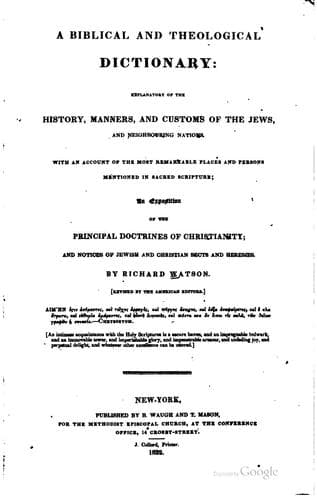
A Biblical and Theological Dictionary: explanatory of the history, manners, and customs of the Jews, and neighbouring nationsWatson, Richard
Religion
A Biblical and Theological Dictionary: explanatory of the history, manners, and customs of the Jews, and neighbouring nations
Watson, Richard
Bible -- Dictionaries; Theology -- Dictionaries
It would scarcely be expected that any thing should now remain to guide
us in our search for this ancient city, seeing that Babylon itself, with
which it was coeval, is reduced to heaps; and that it is not mentioned
under its ancient name by any profane author. But the discoveries of
modern travellers may be brought to aid us in our inquiry. At the
distance of about six miles from the modern town of Bagdad, is found a
mound, surmounted by a tower-shaped ruin, called by the Arabs Tell
Nimrood, and by the Turks Nemrood Tepasse; both terms implying the Hill
of Nimrod. This gigantic mass rises in an irregularly pyramidal or
turreted shape, according to the view in which it is taken, one hundred
and twenty-five or one hundred and thirty feet above the gently inclined
elevation on which it stands. Its circumference, at the bottom, is three
hundred feet. The mound which constitutes its foundation is composed of
a collection of rubbish, formed from the decay of the superstructure;
and consists of sandy earth, fragments of burnt brick, pottery, and hard
clay, partially vitrified. In the remains of the tower, the different
layers of sun-dried brick, of which it is composed, may be traced with
great precision. These bricks, cemented together by slime, and divided
into courses varying from twelve to twenty feet in height, are separated
from one another by a stratum of reeds, similar to those now growing in
the marshy parts of the plain, and in a wonderful state of preservation.
The resemblance of this mode of building to that in some of the
structures at Babylon, cannot escape observation; and we may reasonably
conclude it to be the workmanship of the same architects. The solidity
and the loftiness of this pile, unfashioned to any other purpose,
bespeak it to be one of those enormous pyramidal towers which were
consecrated to the Sabian worship; which, as essential to their
religious rites, were probably erected in all the early cities of the
Cuthites; and, like their prototype at Babylon, answered the double
purpose of altars and observatories. Here then was the site of one of
these early cities. It was not Babylon; it was not Erech; it was not
Calneh. It might be too much to say that _therefore_ it must be Accad;
but the inference is at least warrantable; which is farther strengthened
by the name of the place, Akarkouff; which bears a greater affinity to
that of Accad than many others which are forced into the support of
geographical speculations, especially when it is recollected that the
Syrian name of the city was Achar.
Public-domain text, read in full here on John Shaqi.
Reviews
Reviews
No reviews yet
Be the first to share your thoughts on this work.
Join the Discussion
Join the discussion
Sign in to leave a comment or review.
Sign InorCreate an account