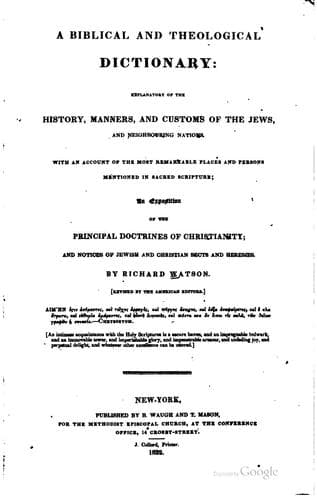
A Biblical and Theological Dictionary: explanatory of the history, manners, and customs of the Jews, and neighbouring nationsWatson, Richard
Religion
A Biblical and Theological Dictionary: explanatory of the history, manners, and customs of the Jews, and neighbouring nations
Watson, Richard
Bible -- Dictionaries; Theology -- Dictionaries
Among its antiquities, Dr. E. D. Clarke describes the remains of a very
considerable edifice, exhibiting a conspicuous appearance among the
buildings on the north side of the city. “In this structure the style of
the architecture is of the kind we call Gothic. Perhaps it has on that
account borne among our countrymen the appellation of ‘King Richard’s
Palace,’ although, in the period to which the tradition refers, the
English were hardly capable of erecting palaces, or any other buildings
of equal magnificence. Two lofty arches, and part of the cornice, are
all that now remain to attest the former greatness of the
superstructure. The cornice, ornamented with enormous stone busts,
exhibiting a series of hideous distorted countenances, whose features
are in no instances alike, may either have served as allusions to the
decapitation of St. John, or were intended for a representation of the
heads of Saracens suspended as trophies upon the walls.” Maundrell and
Pococke consider this building to have been the church of St. Andrew;
but Dr. E. D. Clarke thinks it was that of St. John, erected by the
Knights of Jerusalem, whence the city changed its name of Ptolemais for
that of St. John d’Acre. He also considers the style of architecture to
be in some degree the original of our ornamented Gothic, before its
translation from the holy land to Italy, France, and England.
Mr. Buckingham, who visited Acre in 1816, says, “Of the Canaanitish
Accho it would be thought idle perhaps to seek for remains; yet some
presented themselves to my observation so peculiar in form and
materials, and of such high antiquity, as to leave no doubt in my own
mind of their being the fragments of buildings constructed in the
earliest ages.
“Of the splendour of Ptolemais, no perfect monument remains; but
throughout the town are seen shafts of red and grey granite, and marble
pillars. The Saracenic remains are only to be partially traced in the
inner walls of the town; which have themselves been so broken down and
repaired, as to leave little visible of the original work; and all the
mosques, fountains, bazaars, and other public buildings, are in a style
rather Turkish than Arabic, excepting only an old, but regular and
well-built khan or caravanserai, which might perhaps be attributed to
the Saracen age. The Christian ruins are altogether gone, scarcely
leaving a trace of the spot on which they stood.”
Acre has been rendered famous in our own times by the successful
resistance made by our countryman Sir Sydney Smith, aided by the
celebrated Djezzar Pasha, to the progress of the French under
Buonaparte. Since this period, the fortifications have been considerably
increased; and although to the eye of an engineer they may still be very
defective, Acre may be considered as the strongest place in Palestine.
Public-domain text, read in full here on John Shaqi.
Reviews
Reviews
No reviews yet
Be the first to share your thoughts on this work.
Join the Discussion
Join the discussion
Sign in to leave a comment or review.
Sign InorCreate an account