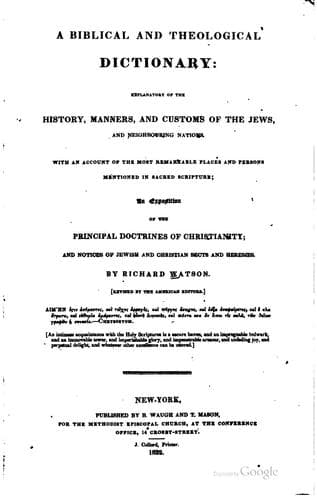
A Biblical and Theological Dictionary: explanatory of the history, manners, and customs of the Jews, and neighbouring nations — John Shaqi
A Biblical and Theological Dictionary: explanatory of the history, manners, and customs of the Jews, and neighbouring nationsWatson, Richard
Religion
A Biblical and Theological Dictionary: explanatory of the history, manners, and customs of the Jews, and neighbouring nations
Watson, Richard
Bible -- Dictionaries; Theology -- Dictionaries
Mr. Conner says, on the authority of the English consul, that there are
about ten thousand inhabitants in Acre, of whom three thousand are
Turks, and the remainder Christians, chiefly Catholics.
ACCUBATION, the posture used at table by the ancients. The old Romans
sat at meat as we do, till the Grecian luxury and softness had corrupted
them. The same custom, of lying upon couches at their entertainments,
prevailed among the Jews also in our Saviour’s time; for having been
lately conquered by Pompey, they conformed in this, and in many other
respects, to the example of their masters. The manner of lying at meat
among the Romans, Greeks, and more modern Jews, was the same in all
respects. The table was placed in the middle of the room, around which
stood three couches covered with cloth or tapestry, according to the
quality of the master of the house; upon these they lay, inclining the
superior part of their bodies upon their left arms, the lower part being
stretched out at full length, or a little bent. Their heads were
supported and raised with pillows. The first man lay at the head of the
couch; the next man lay with his head toward the feet of the other, from
which he was defended by the bolster that supported his own back,
commonly reaching over to the middle of the first man; and the rest
after the same manner. The most honourable place was the _middle_
couch--and the _middle_ of _that_. Favourites commonly lay in the bosom
of their friends; that is, they were placed next below them: see John
xiii, 23, where St. John is said to have lain in our Saviour’s bosom.
The ancient Greeks sat at the table; for Homer observes that when
Ulysses arrived at the palace of Alcinous, the king dispatched his son
Laodamas to seat Ulysses in a magnificent chair. The Egyptians sat at
table anciently, as well as the Romans, till toward the end of the Punic
war, when they began to recline at table.
Public-domain text, read in full here on John Shaqi.
Reviews
Reviews
No reviews yet
Be the first to share your thoughts on this work.
Join the Discussion
Join the discussion
Sign in to leave a comment or review.
Sign InorCreate an account