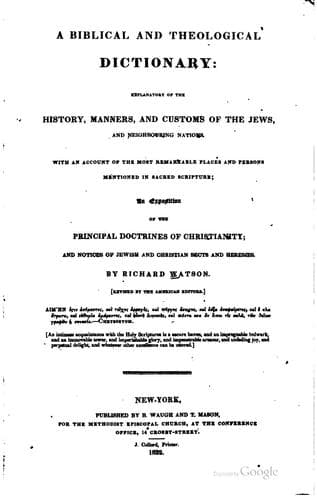
A Biblical and Theological Dictionary: explanatory of the history, manners, and customs of the Jews, and neighbouring nations — John Shaqi
A Biblical and Theological Dictionary: explanatory of the history, manners, and customs of the Jews, and neighbouring nationsWatson, Richard
Religion
A Biblical and Theological Dictionary: explanatory of the history, manners, and customs of the Jews, and neighbouring nations
Watson, Richard
Bible -- Dictionaries; Theology -- Dictionaries
ACCURSED, in the Scriptures, signifies that which is separated or
devoted. With regard to persons, it denotes the cutting off or
separating any one from the communion of the church, the number of the
living, or the privileges of society; and also the devoting an animal,
city, or other thing to destruction. _Anathema_ was a species of
_excommunication_ among the Jews, and was often practised after they had
lost the power of life and death, against those persons who, according
to the Mosaic law, ought to have been executed. A criminal, after the
sentence of excommunication was pronounced, became _anathema_: and they
had a full persuasion that the sentence would not be in vain; but that
God would interfere to punish the offender in a manner similar to the
penalty of the law of Moses: a man, for instance, whom the law condemned
to be stoned, would, they believed, be killed by the falling of a stone
upon him; a man to be hanged, would be choked; and one whom the law
sentenced to the flames, would be burnt in his house, &c. _Maranatha_, a
Syriac word, signifying _the Lord cometh_, was added to the sentence, to
express their persuasion that the Lord God would come to take vengeance
upon that guilt which they, circumstanced as they were, had not the
power to punish, 1 Cor. xvi, 22.
According to the idiom of the Hebrew language, _accursed_ and
_crucified_ were synonymous terms. By the Jews every one who died upon a
tree was reckoned _accursed_, Deut. xxi, 23.
Excommunication is a kind of anathema also among some Christians; and by
it the offender is deprived, not only of communicating in prayers and
other holy offices, but of admittance to the church, and of conversation
with the faithful. The spirit of Judaism, rather than that of the
Gospel, has in this been imitated; for among the Hebrews, they who were
excommunicated could not perform any public duty of their employments;
could be neither judges nor witnesses; neither be present at funerals,
nor circumcise their own sons, nor sit down in the company of other men,
nearer than within the distance of four cubits. If they died under
excommunication, they were denied the rites of burial; and a large stone
was left on their graves, or a heap of stones was thrown over them, as
over Achan, Joshua vii, 26. The Apostolical excommunication was simply
to deny to the offender, after admonition, the right of partaking of the
Lord’s Supper, which was excision from the church of Christ.
ACELDAMA, a piece of ground without the south wall of Jerusalem, on the
other side of the brook Siloam. It was called the Potter’s Field,
because an earth or clay was dug in it, of which pottery was made. It
was likewise called the Fuller’s Field, because cloth was dried in it.
But it having been afterward bought with the money by which the high
priest and rulers of the Jews purchased the blood of Jesus, it was
called Aceldama, or the Field of Blood.
Public-domain text, read in full here on John Shaqi.
Reviews
Reviews
No reviews yet
Be the first to share your thoughts on this work.
Join the Discussion
Join the discussion
Sign in to leave a comment or review.
Sign InorCreate an account