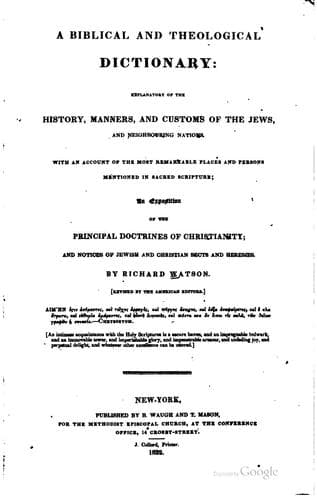
A Biblical and Theological Dictionary: explanatory of the history, manners, and customs of the Jews, and neighbouring nationsWatson, Richard
Religion
A Biblical and Theological Dictionary: explanatory of the history, manners, and customs of the Jews, and neighbouring nations
Watson, Richard
Bible -- Dictionaries; Theology -- Dictionaries
ACHAIA. This name is used to denote the whole of Greece, as it existed
as a Roman province; or Achaia Proper, a district in the northern part
of the Peloponnesus, on the bay of Corinth, and in which the city of
that name stood. It appears to have been used in the former sense in 2
Cor. xi, 10; and in the latter, in Acts xix, 21.
ACHAN, the son of Carmi, of the tribe of Judah, who having taken a part
of the spoils of Jericho, against the injunction of God, who had
_accursed_ or devoted the whole city, was, upon being taken by lot,
doomed to be stoned to death. The whole history is recorded, Joshua vii.
It would appear that Achan’s family were also stoned; for they were led
out with him, and all his property, “And all Israel stoned him with
stones, and burned them with fire, after they had stoned them with
stones.” Some of the critics have made efforts to confine the stoning to
Achan, and the burning to his goods; but not without violence to the
text. It is probable, therefore, that his family were privy to the
theft, seeing he hid the accursed things which he had stolen in the
earth, in his tent. By concealment they therefore became partakers of
his crime, and so the sentence was justified.
ACHMETHA. See ECBATANA.
ACHOR, Valley of, between Jericho and Ai. So called from the trouble
brought upon the Israelites by the sin of Achan; Achor in the Hebrew
denoting trouble.
ACHZIB, a city on the coast of the Mediterranean, in the tribe of Asher,
and one of the cities out of which that tribe did not expel the
inhabitants, Judges i, 31. It was called Ecdippa by the Greeks, and is
at present termed Zib. It is situated about ten miles north of Accho, or
Ptolemais. Mr. Buckingham, who passed by this place, says that it is
small, and situated on a hill near the sea; having a few palm trees
rearing themselves above its dwellings.
ACRA, Ἄκρα. This Greek word signifies, in general, _a citadel_. The
Syrians and Chaldeans use הקרא, in the same sense. King Antiochus gave
orders for building a citadel at Jerusalem, north of the temple, on an
eminence, which commanded the holy place; and for that reason was called
Acra. Josephus says, that this eminence was semicircular, and that Simon
Maccabæus, having expelled the Syrians, who had seized Acra, demolished
it, and spent three years in levelling the mountain on which it stood;
that no situation in future should command the temple. On mount Acra
were afterward built, the palace of Helena; Agrippa’s palace, the place
where the public records were lodged; and that where the magistrates of
Jerusalem assembled.
ACRABATENE, a district of Judæa, extending between Shechem (now
Napolose) and Jericho, inclining east. It was about twelve miles in
length. The Acrabatene had its name from a place called Akrabbim, about
nine miles from Shechem, eastward. This was also the name of another
district of Judea on the frontier of Idumea, toward the northern
extremity of the Dead Sea.
Public-domain text, read in full here on John Shaqi.
Reviews
Reviews
No reviews yet
Be the first to share your thoughts on this work.
Join the Discussion
Join the discussion
Sign in to leave a comment or review.
Sign InorCreate an account