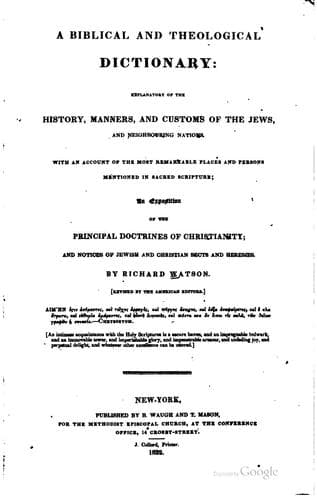
A Biblical and Theological Dictionary: explanatory of the history, manners, and customs of the Jews, and neighbouring nationsWatson, Richard
Religion
A Biblical and Theological Dictionary: explanatory of the history, manners, and customs of the Jews, and neighbouring nations
Watson, Richard
Bible -- Dictionaries; Theology -- Dictionaries
ACTS OF THE APOSTLES. This book, in the very beginning, professes itself
to be a continuation of the Gospel of St. Luke; and its style bespeaks
it to be written by the same person. The external evidence is also very
satisfactory; for besides allusions in earlier authors, and particularly
in Clement of Rome, Polycarp, and Justin Martyr, the Acts of the
Apostles are not only quoted by Irenæus, as written by Luke the
evangelist, but there are few things recorded in this book which are not
mentioned by that ancient father. This strong testimony in favour of the
genuineness of the Acts of the Apostles is supported by Clement of
Alexandria, Tertullian, Jerome, Eusebius, Theodoret, and most of the
later fathers. It may be added, that the name of St. Luke is prefixed to
this book in several ancient Greek manuscripts of the New Testament, and
also in the old Syriac version.
2. This is the only inspired work which gives us any historical account
of the progress of Christianity after our Saviour’s ascension. It
comprehends a period of about thirty years, but it by no means contains
a general history of the church during that time. The principal facts
recorded in it are, the choice of Matthias to be an Apostle in the room
of the traitor Judas; the descent of the Holy Ghost on the day of
pentecost; the preaching, miracles, and sufferings of the Apostles at
Jerusalem; the death of Stephen, the first martyr; the persecution and
dispersion of the Christians; the preaching of the Gospel in different
parts of Palestine, especially in Samaria; the conversion of St. Paul;
the call of Cornelius, the first Gentile convert; the persecution of the
Christians by Herod Agrippa; the preaching of Paul and Barnabas to the
Gentiles, by the express command of the Holy Ghost; the decree made at
Jerusalem, declaring that circumcision, and a conformity to other Jewish
rites and ceremonies, were not necessary in Gentile converts; and the
latter part of the book is confined to the history of St. Paul, of whom
St. Luke was the constant companion for several years.
3. As this account of St. Paul is not continued beyond his two years’
imprisonment at Rome, it is probable that this book was written soon
after his release, which happened in the year 63; we may therefore
consider the Acts of the Apostles as written about the year 64.
4. The place of its publication is more doubtful. The probability
appears to be in favour of Greece, though some contend for Alexandria in
Egypt. This latter opinion rests upon the subscriptions at the end of
some Greek manuscripts, and of the copies of the Syriac version; but the
best critics think, that these subscriptions, which are also affixed to
other books of the New Testament, deserve but little weight; and in this
case they are not supported by any ancient authority.
Public-domain text, read in full here on John Shaqi.
Reviews
Reviews
No reviews yet
Be the first to share your thoughts on this work.
Join the Discussion
Join the discussion
Sign in to leave a comment or review.
Sign InorCreate an account