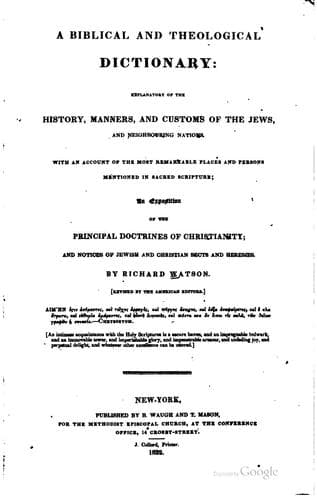
A Biblical and Theological Dictionary: explanatory of the history, manners, and customs of the Jews, and neighbouring nations — John Shaqi
A Biblical and Theological Dictionary: explanatory of the history, manners, and customs of the Jews, and neighbouring nationsWatson, Richard
Religion
A Biblical and Theological Dictionary: explanatory of the history, manners, and customs of the Jews, and neighbouring nations
Watson, Richard
Bible -- Dictionaries; Theology -- Dictionaries
The woman was seduced by the tempter; and she seduced her husband to eat
of the forbidden fruit. When called to judgment for this transgression
before God, Adam attempted to cast the blame upon his wife, and the
woman upon the serpent tempter. But God declared them all guilty, and
punished the serpent by degradation; the woman by painful childbearing
and subjection; and the man by agricultural labour and toil; of which
punishments every day witnesses the fulfilment. As their natural
passions now became irregular, and their exposure to accidents was
great, God made a covering of skins for Adam and for his wife; and
expelled them from the garden, to the country without; placing at the
east of the garden cherubims and a flaming sword, which turned every
way, to keep the way of the tree of life. It is not known how long Adam
and his wife continued in paradise: some say, many years; others, not
many days; others, not many hours. Adam called his wife’s name _Eve_,
which signifies “the mother of all living.” Shortly after, Eve brought
forth Cain, Gen. iv, 1, 2. It is believed that she had a girl at the
time, and that, generally, she had twins. The Scriptures notice only
three sons of Adam: Cain, Abel, and Seth; and omits daughters; except
that Moses tells us, “Adam begat sons and daughters;” no doubt many. He
died, aged nine hundred and thirty, B. C. 3074.
Upon this history, so interesting to all Adam’s descendants, some
remarks may be offered.
1. It is disputed whether the name _Adam_ is derived from _red earth_.
Sir W. Jones thinks it may be from _Adim_, which in Sanscrit signifies,
_the first_. The Persians, however, denominate him Adamah, which
signifies, according to Sale, _red earth_. The term for woman is
_Aisha_, the feminine of _Aish_, man, and signifies, therefore, maness
or female man.
Public-domain text, read in full here on John Shaqi.
Reviews
Reviews
No reviews yet
Be the first to share your thoughts on this work.
Join the Discussion
Join the discussion
Sign in to leave a comment or review.
Sign InorCreate an account