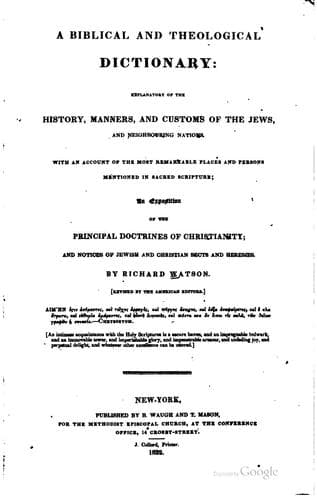
A Biblical and Theological Dictionary: explanatory of the history, manners, and customs of the Jews, and neighbouring nations — John Shaqi
A Biblical and Theological Dictionary: explanatory of the history, manners, and customs of the Jews, and neighbouring nationsWatson, Richard
Religion
A Biblical and Theological Dictionary: explanatory of the history, manners, and customs of the Jews, and neighbouring nations
Watson, Richard
Bible -- Dictionaries; Theology -- Dictionaries
2. The manner in which the creation of Adam is narrated indicates
something peculiar and eminent in the being to be formed. Among the
heavenly bodies the earth, and above all the various productions of its
surface, vegetable and animal, however perfect in their kinds, and
beautiful and excellent in their respective natures, not one being was
found to whom the rest could minister instruction; inspire with moral
delight; or lead up to the Creator himself. There was, properly
speaking, no intellectual being; none to whom the whole frame and
furniture of material nature could minister knowledge; no one who could
employ upon them the generalizing faculty, and make them the basis of
inductive knowledge. If, then, it was not wholly for himself that the
world was created by God; and if angels were not so immediately
connected with this system, as to lead us to suppose that it was made
for them; a rational inhabitant was obviously still wanting to complete
the work, and to constitute a perfect whole. The formation of such a
being was marked, therefore, by a manner of proceeding which serves to
impress us with a sense of the greatness of the work. Not that it could
be a matter of more difficulty to Omnipotence to create man than any
thing beside; but principally, it is probable, because he was to be the
lord of the whole and therefore himself accountable to the original
proprietor; and was to be the subject of another species of government,
a moral administration; and to be constituted an image of the
intellectual and moral perfections, and of the immortality, of the
common Maker. Every thing therefore, as to man’s creation, is given in a
solemn and deliberative form, and contains also an intimation of a
Trinity of Persons in the Godhead, all equally possessed of _creative_
power, and therefore _Divine_, to each of whom man was to stand in
relations the most sacred and intimate:--“And God said, Let US make man
in our image, after our likeness; and let them have dominion,” &c.
3. It may be next inquired in what that image of God in which man was
made consists.
It is manifest from the history of Moses, that human nature has two
essential constituent parts, the BODY formed out of preëxisting matter,
the earth; and a LIVING SOUL, breathed into the body by an _inspiration_
from God. “And the Lord God formed man out of the dust of the ground,
and breathed into his nostrils (or _face_) the breath of life,
(_lives_,) and man became a living soul.” Whatever was thus imparted to
the body of man, already “_formed_,” and perfectly finished in all its
parts, was the only cause of life; and the whole tenor of Scripture
shows that this was the rational spirit itself, which, by a law of its
Creator, was incapable of death, even after the body had fallen under
that penalty.
Public-domain text, read in full here on John Shaqi.
Reviews
Reviews
No reviews yet
Be the first to share your thoughts on this work.
Join the Discussion
Join the discussion
Sign in to leave a comment or review.
Sign InorCreate an account