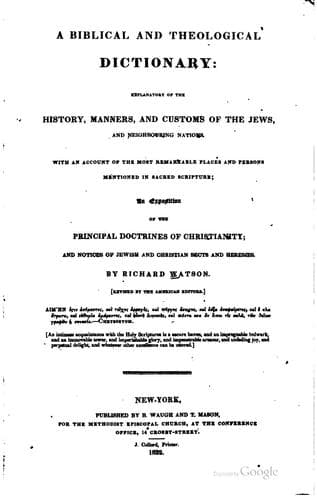
A Biblical and Theological Dictionary: explanatory of the history, manners, and customs of the Jews, and neighbouring nations — John Shaqi
A Biblical and Theological Dictionary: explanatory of the history, manners, and customs of the Jews, and neighbouring nationsWatson, Richard
Religion
A Biblical and Theological Dictionary: explanatory of the history, manners, and customs of the Jews, and neighbouring nations
Watson, Richard
Bible -- Dictionaries; Theology -- Dictionaries
but a virgin only; whereas the other priests might lawfully marry a
widow, Lev. xxi, 7.
In the following particulars the high priest and inferior priests agreed
in their consecration: both were to be void of bodily blemish--both were
to be presented to the Lord at the door of the tabernacle--both were to
be washed with water--both were to be consecrated by offering up certain
sacrifices--both were to have the blood of a ram put upon the tip of the
right ear, the thumb of the right hand, and the great toe of the right
foot, Exod. xxix, 20. In the time of consecration, certain pieces of the
sacrifice were put into the priest’s hand, which was called “filling his
hand;” hence the Hebrew phrase, “to fill the hand,” signifies
consecration.
In the discharge of their offices, the high priest differed from the
other priests in these particulars: the high priest only, and that but
once a year, might enter into the holy of holies--the high priest might
not mourn for his nearest relations by uncovering his head, or tearing
any part of his garments, except the skirt; whereas the priest was
allowed to mourn for these six,--father, mother, son, daughter, brother,
and sister if she had no husband, Lev. xxi, 2, 10, 11; but they agreed
in these respects: they both burnt incense and offered sacrifices--they
both sounded the trumpet, either as an alarm in war, or to assemble the
people and their rulers--they both slew the sacrifices--both instructed
the people--and both judged of leprosy.
For the more orderly performance of these offices, the high priest had
his sagan, who, in case of the high priest’s pollution, performed his
duty. The high priest and his sagan resembled our bishop and his
suffragan.
3. Aaron was a TYPE of Christ, not personally, but as the high priest of
the Jewish church. All the priests, as offering gifts and sacrifices,
were in their office types of Christ; but Aaron especially, 1. As the
high priest. 2. In entering into the holy place on the great day of
atonement, and reconciling the people to God; in making intercession for
them, and pronouncing upon them the blessing of Jehovah, at the
termination of solemn services. 3. In being anointed with the holy oil
by _effusion_, which was prefigurative of the Holy Spirit with which our
Lord was endowed. 4. In bearing the names of all the tribes of Israel
upon his breast and upon his shoulders, thus presenting them always
before God, and representing them to him. 5. In being the medium of
their inquiring of God by urim and thummim; and of the communication of
his will to them. But though the offices of Aaron were typical, the
priesthood of Christ is of a different and higher ORDER than his,
namely, that of MELCHIZEDECK. See CALF, PRIEST, TYPE, EPHOD,
BREASTPLATE, URIM.
Public-domain text, read in full here on John Shaqi.
Reviews
Reviews
No reviews yet
Be the first to share your thoughts on this work.
Join the Discussion
Join the discussion
Sign in to leave a comment or review.
Sign InorCreate an account