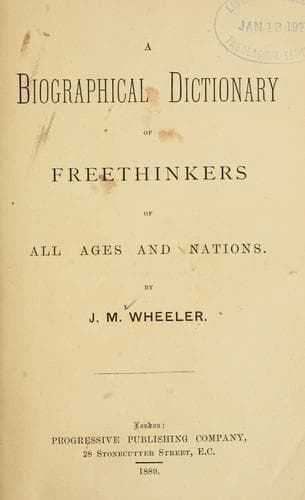
A Biographical Dictionary of Freethinkers of All Ages and NationsWheeler, J. M. (Joseph Mazzini)
Religion
A Biographical Dictionary of Freethinkers of All Ages and Nations
Wheeler, J. M. (Joseph Mazzini)
Free thought -- Biography
Adler (Felix) Ph. D. American Freethinker, the son of a Jewish rabbi,
was b. in Alzey, Germany, 13 Aug. 1851. He graduated at Columbia
College, 1870, was professor of Hebrew and Oriental literature
at Cornell University from '74 to May '76, when he established in
New York the Society of Ethical Culture, to which he discourses on
Sundays. In 1877 he published a volume entitled Creed and Deed, in
which he rejects supernatural religion. Dr. Adler has also contributed
many papers to the Radical literature of America.
Ænesidemus. A Cretan sceptical philosopher of the first century. He
adopted the principle of Heraclitus, that all things were in course
of change, and argued against our knowledge of ultimate causes.
Airy (Sir George Biddell). English Astronomer Royal, b. Alnwick
27 July, 1801. Educated at Cambridge, where he became senior
wrangler 1823. During a long life Professor Airy did much to advance
astronomical science. His Notes on the Earlier Hebrew Scriptures 1876,
proves him to have been a thorough-going Freethinker.
Aitkenhead (Thomas), an Edinburgh student aged eighteen, who was
indicted for blasphemy, by order of the Privy Council, for having
called the Old Testament "Ezra's Fables," and having maintained
that God and nature were the same. He was found guilty 24 Dec. 1696,
and hanged for blasphemy, 8 Jan. 1697.
Aitzema (Lieuwe van), a nobleman of Friesland, b. at Dorckum 19
Nov. 1600, author of a suppressed History of the Netherlands, between
1621-68. Is classed by Reimmann as an Atheist. Died at the Hague 23
Feb. 1669.
Akbar (Jalal-ed-din Muhammad), the greatest of the emperors of
Hindostan, b. 15 Oct. 1542, was famous for his wide administration and
improvement of the empire. Akbar showed toleration alike to Christians,
Muhammadans, and to all forms of the Hindu faith. He had the Christian
gospels and several Brahmanical treatises translated into Persian. The
result of his many conferences on religion between learned men of
all sects, are collected in the Dabistan. Akbar was brought up as a
Muhammadan, but became a Theist, acknowledging one God, but rejecting
all other dogmas. Died Sept. 1605.
Alberger (John). American author of Monks, Popes, and their Political
Intrigues (Baltimore, 1871) and Antiquity of Christianity (New York,
1874).
Albini (Giuseppe). Italian physiologist, b. Milan. In 1845 he
studied medicine in Paris. He has written on embryology and many
other physiological subjects.
Alchindus. Yakub ibn Is'hak ibn Subbah (Abú Yúsuf) called Al Kindi,
Arab physician and philosopher, the great grandson of one of the
companions of Muhammad, the prophet, flourished from 814 to about
840. He was a rationalist in religion, and for his scientific studies
he was set down as a magician.
Public-domain text, read in full here on John Shaqi.
Reviews
Reviews
No reviews yet
Be the first to share your thoughts on this work.
Join the Discussion
Join the discussion
Sign in to leave a comment or review.
Sign InorCreate an account