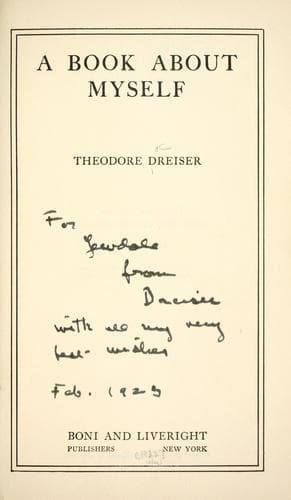
Dreiser, Theodore, 1871-1945; Journalists -- United States -- Biography; Novelists, American -- 20th century -- Biography
The conference took place the next day and of the five men who had been
taken on to do extra work during the convention I and one other were the
only ones retained, and this at the expense of two former reporters
dropped. At that, I really believe I should have been sent off if it had
not been for Maxwell. He had been present during most of the
transactions concerning Mr. Gissel’s book and thought I deserved work on
that score alone, to say nothing of my subsequent efforts. I think he
disliked the little editorial writer very much. At any rate when this
conference began Maxwell, according to Dunlap who was there and reported
to me, sat back, a look of contented cynicism on his face not unlike
that of a fox about to devour a chicken. The names of several of the new
men were proposed as substitutes for the old ones when, not hearing mine
mentioned, he inquired:
“Well, what about Dreiser?”
“Well, what about him?” retorted Sullivan, the city editor. “He’s a good
man, but he lacks training. These other fellows are experienced.”
“I thought you and Gissel sort of agreed to give him a show if he sold
that book for you?”
“No, I didn’t,” said Sullivan. “I only promised to give him a tryout
around convention time. I’ve done that.”
“But he’s the best man on the staff today,” insisted Maxwell. “He
brought in the only piece of news worth having. He’s writing better
every day.”
He bristled, according to Dunlap, and Sullivan and Gissel, taking the
hint that the quarrel might be carried higher up or aired
inconveniently, changed their attitude completely.
“Oh, well,” said Sullivan genially, “let him come on. I’d just as lief
have him. He may pan out.”
And so on I came, at fifteen dollars a week, and thus my newspaper
career was begun in earnest.
------------------------------------------------------------------------
CHAPTER XII
THIS change from insecurity to being an accredited newspaper man was
delightful. For a very little while, a year or so, it seemed to open up
a clear straight course which if followed energetically must lead me to
great heights. Of course I found that beginners were very badly paid.
Salaries ranged from fourteen to twenty-five dollars for reporters; and
as for those important missions about which I had always been reading,
they were not even thought of here. The best I could learn of them in
this office was that they did exist—on some papers. Young men were still
sent abroad on missions, or to the West or to Africa (as Stanley), but
they had to be men of proved merit or budding genius and connected with
papers of the greatest importance. How could one prove oneself to be a
budding genius?
Public-domain text, read in full here on John Shaqi.
Reviews
Reviews
No reviews yet
Be the first to share your thoughts on this work.
Join the Discussion
Join the discussion
Sign in to leave a comment or review.
Sign InorCreate an account