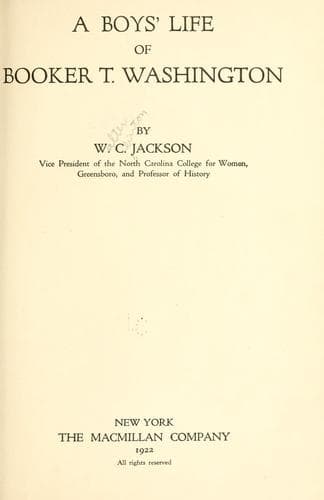
A boys' life of Booker T. WashingtonJackson, Walter Clinton
History
A boys' life of Booker T. Washington
Jackson, Walter Clinton
African American educators -- Biography -- Juvenile literature; Washington, Booker T., 1856-1915 -- Juvenile literature
He organized a debating society for the men and boys. He opened a night
school so that those who worked and could not go to school during the
day could go at night. He established a reading room. He taught several
boys privately in order to get them ready to enter Hampton. He taught in
two Sunday schools. In fact, he did more to make his community a good,
clean, happy community than anybody had ever done before.
One of the good things he did was to help his brother John who had
helped him so much while he was at Hampton and now wanted to go to
school himself. What a joy it was to Booker to be able to do something
for this kind and generous brother! John did go to Hampton, as did
another brother, James, who was an adopted child; and both helped
Washington loyally in later years at Tuskegee.
After teaching two years at Malden, Washington decided to go to school
again. This time he went to Washington, D. C., and entered Wayland
Seminary, where he remained eight months. He did not care so much for
his work here. It was very different from the work at Hampton. The
students were all well dressed. They did not have to work as they did at
Hampton. They had plenty of money, and their studies were different.
They did not have trades, industries, agricultural work, or dairying, or
anything of that kind. They had Latin and Greek and literature and
higher mathematics and other studies of a similar kind. Washington felt
that he did not get the benefit that he did at Hampton.
Nor did he like Washington any better than he liked this school. He saw
too much extravagance to suit him. Too many people were trying to get
something for nothing. Too many of them were trying to get jobs with the
Federal Government that would be easy work and high pay. Many of the
negroes seemed to think it was the business of the Federal Government to
support them. Washington did not think this was right. He thought all
men should do good, honest work, and that, if they didn’t, they would
sooner or later find trouble. He was glad to get away, for he felt that
the life that most of the negroes lived at that time in Washington was
most unsatisfactory.
Public-domain text, read in full here on John Shaqi.
Reviews
Reviews
No reviews yet
Be the first to share your thoughts on this work.
Join the Discussion
Join the discussion
Sign in to leave a comment or review.
Sign InorCreate an account