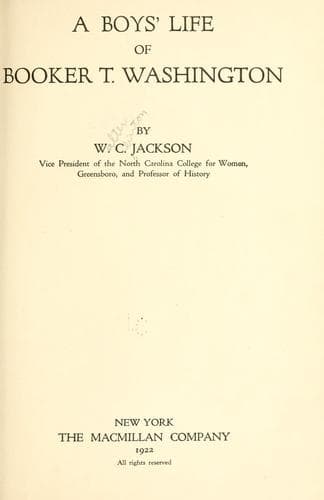
A boys' life of Booker T. WashingtonJackson, Walter Clinton
History
A boys' life of Booker T. Washington
Jackson, Walter Clinton
African American educators -- Biography -- Juvenile literature; Washington, Booker T., 1856-1915 -- Juvenile literature
At the end of the eight months, he returned to Malden again. At this
time there was a big campaign on in West Virginia to remove the capital,
which was located at Wheeling. It was far up in the northern part of the
state. Many of the people wanted another city to be chosen. The
legislature selected three cities to be voted upon by the people and
Charleston was one of these. Malden, you remember, was five miles from
Charleston. Just after he returned from Washington, Booker was greatly
pleased to receive an invitation from a committee of white men to come
to Charleston and then go on a speaking tour in behalf of that city. He
accepted the invitation, and for three months he went about the state
speaking for Charleston as the capital. When the election was held,
Charleston won; and no small part of the credit was due to the brilliant
speeches made by the young negro teacher of Malden.
He made such a reputation as a speaker in this campaign that everybody
took it for granted that he would now study law and enter politics. A
well-known judge tried to persuade him to do this and offered to teach
him law. This was very flattering, and for a while Washington considered
it. But all the time he had the feeling that there was something else he
must do. He felt that he could succeed in law and politics, but he also
felt that it would be selfish; that he would be doing something largely
to benefit himself only.
Most of the negro men in politics, at that time, were vicious and
ignorant. Of course there were many exceptions; but, as a general thing,
the negro who was in politics during that period was uneducated and
often dishonest. Washington tells of passing a crowd of men one day as
they were at work on a building. He heard the men saying to one of the
others, “Hurry up, Gov.,” and “Hurry, Governor.” He paid no attention at
first but finally made inquiry and found that the negro spoken to had at
one time been the lieutenant governor of the state.
Washington felt that the greatest thing he could do was to engage in the
kind of work that would help his own people most. He did not want to
preach. He thought there were too many preachers already. He had the
belief that the most important thing to do was to engage in the kind of
work that would fit men of his own race to be good preachers, good
teachers, and good citizens.
In the midst of these thoughts, and before he had definitely made up his
mind as to his career, he received a letter from General Armstrong,
inviting him to deliver the “postgraduate” address at Hampton at
commencement, 1879. This honor brought Washington great joy. He accepted
the invitation and chose as his subject, “The Force That Wins.” He
worked hard for three months on his speech. It made a great impression
on all who heard it, and he was acclaimed one of the real orators of his
race.
CHAPTER VI
BACK AT HAMPTON
Public-domain text, read in full here on John Shaqi.
Reviews
Reviews
No reviews yet
Be the first to share your thoughts on this work.
Join the Discussion
Join the discussion
Sign in to leave a comment or review.
Sign InorCreate an account