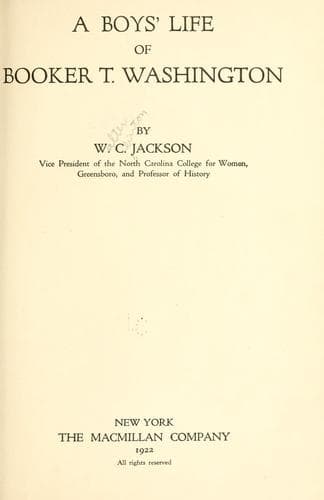
A boys' life of Booker T. WashingtonJackson, Walter Clinton
History
A boys' life of Booker T. Washington
Jackson, Walter Clinton
African American educators -- Biography -- Juvenile literature; Washington, Booker T., 1856-1915 -- Juvenile literature
There is an old saying that “opportunity knocks but once” upon our door.
This is not true. Opportunities will certainly continue to come to us.
The important thing is to be ready for them when they come. We never
know what incident may turn out to be our greatest opportunity. If we
will do our best to meet every situation that confronts us, we may be
sure that there will be plenty of opportunities for us. It is the boy
that does not do his best on all occasions that loses out. So
Washington, when invited to speak at Hampton commencement, worked hard
for three months preparing that speech. When the time came, he did his
very best. Then he forgot the matter and went home. Just a few days
after he got home, he had a great surprise. There came a letter to him
from General Armstrong. It said, “We need you here at Hampton. We want
you to come and help us run the school.”
That was a very happy moment in the life of Washington. He thought more
of General Armstrong than of any other man in the world. To be asked by
this man to come and work for him made Washington an exceedingly happy
man. He immediately wrote that he would accept the position. Some weeks
later he reached Hampton, ready to enter upon his new duties.
His job was a rather peculiar one. The Indians in the United States, who
had been put upon certain territories out West, after being taken from
their land in the South and Southwest, had no system of education and
were entirely without schools of any kind.
General Armstrong wanted to help them. He said he believed that they
could be educated, and he wanted to try it. The Government of the United
States gave its consent and agreed to cooperate with him.
They brought from the West to Hampton about one hundred Indian boys to
be educated. These boys were very ignorant; Booker Washington says that
they were almost wild.
Washington’s task was to live in the same building with these Indian
boys and look after them—to be a sort of “house father” to them.
He had a hard job. The Indians are a very proud people. They felt
themselves superior to the white race, as well as to the black race.
They had a special dislike for the negro because he had been a slave,
and the Indians would not be slaves; they preferred death to slavery.
These boys were not only very ignorant, but it was very hard to make
them understand, as they did not know the English language well.
Furthermore, everybody expected them to fail.
Public-domain text, read in full here on John Shaqi.
Reviews
Reviews
No reviews yet
Be the first to share your thoughts on this work.
Join the Discussion
Join the discussion
Sign in to leave a comment or review.
Sign InorCreate an account