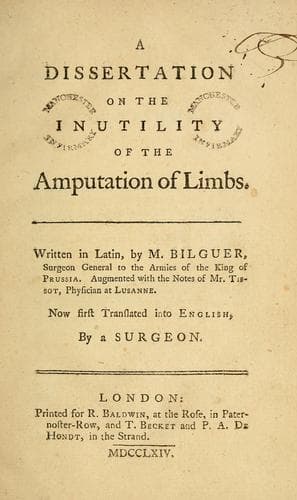
A dissertation on the inutility of the amputation of limbsBilguer, Johann Ulrich
History
A dissertation on the inutility of the amputation of limbs
Bilguer, Johann Ulrich
Amputation -- Early works to 1800
[7] Mr. Ranby, however, who was one of the surgeons of the British
troops at the time of the battle of Dettingen, lays great stress upon
the bark: It is true, that in one of his cases, having ordered it to
an officer of seventy years of age, whose leg had been amputated, _on
account of his ancle, with the neighbouring parts, having been terribly
shattered by a cannon ball_, it did not keep the sore from growing
worse, or prevent the patient's death. But that we may form a just
estimate of the merit of the bark, and the effects of amputation at
the same time, it will be necessary to compare this case with the one
which precedes it. This comparison will, I imagine, be of use.----I
shall quote the author's own words. “An Austrian officer, who had his
hand miserably shattered by a cannon ball, was, by some accident, left
in a wood near the field of battle, destitute of any manner of help,
from Thursday till the Sunday following, when he was brought to Hanau.
The next morning I was carried to see him, and to assist in taking off
his arm. On viewing it, I found it mortified almost to the elbow, with
a great swelling and inflammation quite up to the shoulder. As it was
by no means adviseable to attempt an amputation in such circumstances,
I proposed giving him the bark; which being no ways objected to, he
entered upon immediately. The next day he was rather better: But, on
the third, was evidently so. The inflammation was less, the swelling
began to subside, and the edges of the mortification were separating.
The arm was fomented and wrapped up in the oatmeal and stale beer
poultice, with theriaca: And the dreadful symptoms which forbad the
operation, were now so much abated, that his surgeons did not at all
hesitate to take it off. But this was done to very little purpose;
for three or four days after the amputation, being attacked with
convulsions, he expired.”
I shall here subjoin five questions.
Would Mr. Bilguer have amputated in these two instances?
Would not his method have saved both these patients, especially the
last?
Does not amputation seem to have contributed to their death?
Does it not evidently appear, that in the latter of these two cases,
amputation destroyed the good effects of the bark, which seemed to
conduct the patient to a speedy cure; and that in the former case, the
bark had not power sufficient to repair the mischief occasioned by the
amputation?
Does it not follow from these two observations, that however salutary
the effects of the bark may be, those of amputation are hurtful in a
greater degree? TISSOT.
SECT. VIII.
Public-domain text, read in full here on John Shaqi.
Reviews
Reviews
No reviews yet
Be the first to share your thoughts on this work.
Join the Discussion
Join the discussion
Sign in to leave a comment or review.
Sign InorCreate an account