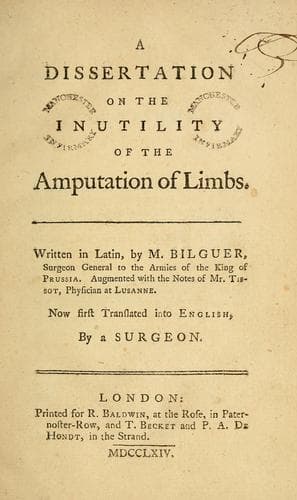
A dissertation on the inutility of the amputation of limbs — John Shaqi
A dissertation on the inutility of the amputation of limbsBilguer, Johann Ulrich
History
A dissertation on the inutility of the amputation of limbs
Bilguer, Johann Ulrich
Amputation -- Early works to 1800
First, A mortification, which spreads till it reaches the bone.
Secondly, Any limb so greatly hurt, whether by fracture or
dilaceration, that there is room to dread the most fatal consequences,
a mortification and death.
Thirdly, A violent contusion of the soft parts, which has at the same
time shattered the bones.
Fourthly, Wounds of the larger vessels, which convey the blood into the
limb, either, as the only means of stopping the hemorrhage, or through
the apprehension the limb should perish for want of nourishment.
Fifthly, An incurable caries of the bone.
Sixthly, If any part is either attacked with a cancer, or is in danger
of being so, it is customary to take it off.
I shall treat of these different accidents more or less particularly,
in proportion to the number of observations I have made on each of
them, as no method of cure, however doubtful and alarming, should
be rejected, till a better can be pointed out. Thus, this treatise
contains only, in effect, an account of the methods I successfully
employed in the military hospitals, for the relief of the above
disorders; together with a few observations, and still fewer
hypothetical reasonings, which induced me to condemn the use of
amputation.
SECT. VII.
I shall begin with an account of the means I make use of, internal
as well as external, when a limb is mortified, the effects of which
have convinced me, that in such cases amputation is not necessary;
and here I shall first gratify the curiosity of those readers who,
doubtless, are desirous to know what I have learned from the extensive
opportunities I must necessarily have had, with respect to the use of
the Peruvian bark.
Experience has taught me, that this admirable medicine is possessed of
a singular and specific virtue in mortifications.
I know that several physicians and surgeons only recommend it in
those which proceed from weakness. I have heard it reported by
others, that they found it of little service after the famous battle
of Dettingen[7]. But perhaps the other circumstances, with regard to
the treatment of the patient, did not contribute to promote those
good effects which I always observed attended it when judiciously
administered. And I make no doubt, but every practitioner who, in
prescribing it in cases of mortification, observes the rules laid
down by Dr. Pringle, Dickins, Wade, Cheselden, Douglas, Rushworth,
Amyand, Shipton and some others, will find it very efficacious. I
do not mean, nevertheless, that it should be considered as the only
internal medicine; there are, doubtless, other bitters which are
sometimes extremely proper on these occasions. I must add, that the
bark appears to me to possess that quality which Celsus requires in
medicines, whether in a solid or liquid form, adapted to the cure of
a mortification, to bind the belly moderately, and brace the whole
system. After having treated of the external applications, I shall
point out the method in which I administered the bark.
FOOTNOTES:
Public-domain text, read in full here on John Shaqi.
Reviews
Reviews
No reviews yet
Be the first to share your thoughts on this work.
Join the Discussion
Join the discussion
Sign in to leave a comment or review.
Sign InorCreate an account