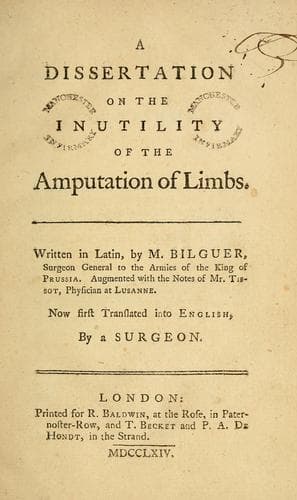
A dissertation on the inutility of the amputation of limbsBilguer, Johann Ulrich
History
A dissertation on the inutility of the amputation of limbs
Bilguer, Johann Ulrich
Amputation -- Early works to 1800
Whenever a mortification attacks any part of the body, whether it be
owing to an outward hurt, or proceeds from an internal cause, as often
happens in persons afflicted with the scurvy, dropsy, a vitiated state
of the blood, phagedenic sores, or very aged people, who begin, as it
were, to die in the extremities: Whenever, I say, the mortification
begins to appear, it requires immediate help. We must begin by making
incisions on the part affected, in order to procure a discharge of
the corrupted matter, and to assist the action of the medicines. I
make long incisions, not only on the mortified parts, but on those
adjacent, which would soon be so; I make several of them, as nearly as
the large trunks of the blood vessels, and more considerable branches
of nerves will allow, not above an inch distant from each other. We
ought always to cut to the quick; and if the bone be affected, the
periosteum must be cut through, and the bone laid bare. These incisions
should follow the direction of the greater number of fibres of the
muscles that happen to be thus cut upon; but when the gastrocnemii,
the glutei or deltoid muscles have been wounded by a ball, they must
be cut cross-ways, otherwise convulsions, particularly the spasmus
cynicus, will probably ensue. Several aponeuroses, especially that of
the biceps, ought likewise to be cut transversally: It is true, if the
longitudinal incisions are sufficiently long and numerous, they take
off the tension of these membranes so much as to render the transversal
ones unnecessary.
Neither ought the tendons to be spared; they must be boldly cut through
transversally.
If a wound, or any other ailment, happens near the articulations, I
also, without fear, make large incisions through the ligaments.
It will easily be understood that these incisions must differ from
each other in length and depth; they must be longer in those parts
of the sore where the disease has spread the widest, and shorter in
others. Both must be more superficial at their extremities, and deeper
in the middle, in the place where the complaint began, and where the
mortification reaches deepest.
The number of incisions, and their distance, must also vary, as they
may be found necessary; so that a skilful surgeon may make three, four,
six or eight, as the case may require.
It is obvious, that in an operation of this kind, a surgeon should not
be too precipitate; and when he does not know the depth of the ailment,
he should not go too deep with his incision: he may repeat it if he
finds he has not reached the quick.
SECT. IX.
Public-domain text, read in full here on John Shaqi.
Reviews
Reviews
No reviews yet
Be the first to share your thoughts on this work.
Join the Discussion
Join the discussion
Sign in to leave a comment or review.
Sign InorCreate an account