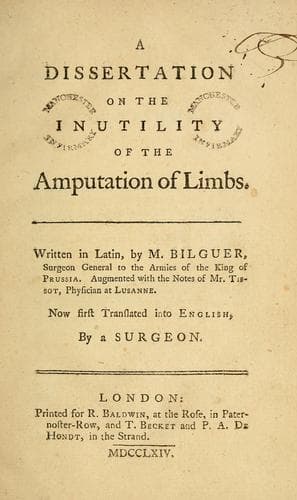
A dissertation on the inutility of the amputation of limbsBilguer, Johann Ulrich
History
A dissertation on the inutility of the amputation of limbs
Bilguer, Johann Ulrich
Amputation -- Early works to 1800
Such kind of wounds, however, are not without danger; the patient is
not only very liable to be seized with such a fever as I have spoken of
§ XXIII. but he also runs a risque from the wound itself. It is true,
that these two dangers, that attending the fever, and that from the
wound, which I shall mention by and bye, are connected, and generally
accompany each other. It sometimes happens of a sudden, and without
the patient, or the physicians and surgeons having any suspicion of
it, that the wounds dry up, become corrupted, and exhale an infectious
stench; the neighbouring parts are very much inflamed for some days,
after which the inflammation goes off, leaving a kind of œdematous
tumour, which produces an abscess, with a laudable discharge, or
degenerates into a malignant sore, without any abscess. Sometimes these
sores are beset with swarms of maggots.
The treatment of the fever is the same I have described § XXIII. that
of the wound, in this troublesome situation, ought to be to endeavour
intirely to remove the inflammation, which readily terminates in
suppuration, and forms large cavities full of matter, which must be
opened.
A moderate compression of the neighbouring parts, in this case, as in
those I have already mentioned, contributes to prevent the reabsorption
of the purulent matter. If the inflammation runs high, and the patient
is young, it should be moderated by bleeding, and other medicines
calculated to check and resolve the inflammatory denseness of the
blood[26].
If the cause of the inflammation be obvious, it must be removed; thus
every pointed splinter of a bone must be separated with a knife or saw;
whatever occasions a compression must be taken away, and if there be
any fibrous part causing too great a stricture, it must be cut through,
dilating the wound by incisions of a convenient depth.
The dryness and putrefaction of the wound, may be remedied by dressing
it with the powder composed of sal ammoniac and camphor, mentioned §
X. and by moistening it afterwards with oil of turpentine; or, I cause
the wounds, both the original ones, and those made by the surgeon, to
be dressed with pledgets, dipt in a balsam composed of _four ounces
spirit of wine, half an ounce spirit of turpentine, and three drams
spirit of sal ammoniac_: Afterwards, having first applied the dressings
very thin, the parts must be constantly fomented with some of the
compositions mentioned § XXI.
Public-domain text, read in full here on John Shaqi.
Reviews
Reviews
No reviews yet
Be the first to share your thoughts on this work.
Join the Discussion
Join the discussion
Sign in to leave a comment or review.
Sign InorCreate an account