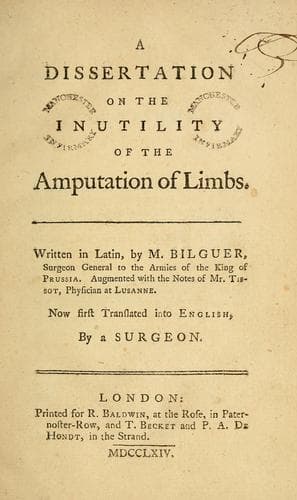
A dissertation on the inutility of the amputation of limbsBilguer, Johann Ulrich
History
A dissertation on the inutility of the amputation of limbs
Bilguer, Johann Ulrich
Amputation -- Early works to 1800
The maggots may be destroyed, by frequently shifting the bandages,
linnen, cloaths, and coverings of the bed; by the application of the
balsams I have already spoken of, which destroy these insects and
prevent putrefaction; by constantly keeping on the bed-clothes, a
linnen cloth dipt in tincture of aloes or vitriol. But care must be
taken that the tincture of aloes does not touch the affected limb,
much less the sores themselves, lest part of it should be absorbed,
and occasion a diarrhæa; although in other respects aloes powerfully
resists putrefaction, and is sometimes a useful vulnerary.
FOOTNOTES:
[26] At present, since we know that pus is only a corruption of the
crassamentum of the blood, it is easier, perhaps, than formerly, to
explain why an inflammatory denseness of the blood terminates sometimes
in an abscess, and at other times in a compleat recovery without one.
Dr. Pringle, to whom we are indebted for so many useful discoveries,
which have thrown a new light on the theory and practice of physic,
was the first who pointed out the true manner in which pus was formed,
concerning which so many conjectures had been made; and Mr. Gaber
has demonstrated it very particularly by a number of very curious
experiments. TISSOT.
SECT. XXVI.
I have had under my care, during the course of this late bloody war, a
great number of wounded limbs, torn and shattered by cannon and musket
balls, by the bursting of bomb-shells and grenades, by grape-shot,
&c. I cured them without ever performing amputation, by the method
described in the two preceding sections, although there were bones
broken and shattered, large blood vessels divided, the flesh miserably
lacerated, and limbs carried off in the manner I have described § XXI.
Others, such as I have described § XXIV. in which the bones were split
up as high as the articulation; all which circumstances might make us
reasonably apprehend a tedious and difficult cure, too plentiful a
suppuration, hemorrhages, violent inflammation, excessive corruption,
mortification and death.
It will perhaps be asked me, Of those men so terribly wounded, whom
you attempted to cure without the means of amputation, did none die? I
shall return an answer by and bye. It will be further objected to me,
that I have not taken notice of the os humeri, or the thigh bone being
shattered; and it will be asked me, What must be done in cases where
either of these bones are fissured as far as their upper extremities,
in such a manner that we cannot hope to procure their coalition by
means of any bandage? And finally, it will be remarked, I have not
mentioned the wounding the brachial or crural arteries, or the large
branches of these which pass between the radius and ulna, or tibia and
fibula, called in both parts the inter-osseous arteries, whether these
wounds be accompanied with a fracture of the bones, or otherwise. I
shall reply to these two last objections, after having answered the
first question in the following section.
Public-domain text, read in full here on John Shaqi.
Reviews
Reviews
No reviews yet
Be the first to share your thoughts on this work.
Join the Discussion
Join the discussion
Sign in to leave a comment or review.
Sign InorCreate an account