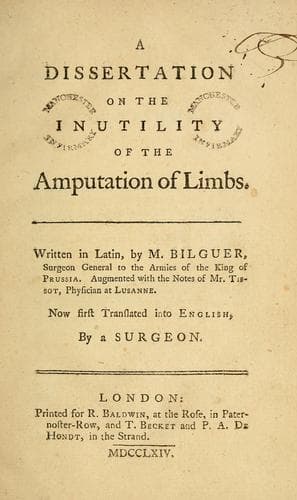
A dissertation on the inutility of the amputation of limbsBilguer, Johann Ulrich
History
A dissertation on the inutility of the amputation of limbs
Bilguer, Johann Ulrich
Amputation -- Early works to 1800
SECT. XXVII.
I had at one time, during the war, in a military hospital, six
thousand six hundred and eighteen wounded patients, who were all
treated according to my direction, and part of whom I attended myself;
of these, five thousand five hundred and fifty-seven were perfectly
cured, and in a condition to support all the fatigues of the service;
a hundred and ninety-five were able to do duty in garrison, what they
call half-invalides[27], or to work at any trade; two hundred and
thirteen remained incapable of any labour, civil or military, what they
call grand invalides[28]; and six hundred and fifty-three died.
These hundred and ninety-five half-invalides, and the two hundred
and thirteen grand invalides, in all, four hundred and eight, were
of the number of those who had their bones bruised, broken and
shattered; of those, in a word, whose wounds were called complicated
and dangerous[29]: For it is well known that with us, a man is not
put on the list of invalides for a wound of the head, or of the
fleshy parts; if, after wounds of this kind are healed up, there
remains any weakness, stiffness, or tension of the part, we employ
various medicines, both internal and external, ointments, liniments,
fomentations, warm baths, by means of which they are commonly
compleatly cured.
Let us at present suppose, that of the six hundred and fifty-three
who died, no more than two hundred and forty-five died from the
consequences either of a violent concussion, from wounds of the head,
thorax, lower belly or spine; from a complicated fracture of the os
femoris, or from putrid fevers, fluxes and other inward diseases, which
often happen in military hospitals, even in cases of slight wounds,
from the bad air which is breathed there; there will remain four
hundred and eight, who may have died from the consequences of wounds
with shattered bones; and this number is equal to that of those who
were cured without amputation, although their wounds had been of the
same kind[30]. If, after making these calculations, we compare them
with the prodigious number of wounded men, who, at the beginning of
the war, had their limbs taken off on account of dangerous wounds, of
whom scarce one or two escaped with their lives; we may very safely
conclude, that much the greater part of those four hundred and eight
men cured and sent to the invalides, would have died if amputation had
been performed on them, and this mocking artificial wound added to
what they had already received. It would be trifling to pretend that
amputation would have saved a great many of those who died, had it been
timeously and properly performed[31].
Public-domain text, read in full here on John Shaqi.
Reviews
Reviews
No reviews yet
Be the first to share your thoughts on this work.
Join the Discussion
Join the discussion
Sign in to leave a comment or review.
Sign InorCreate an account