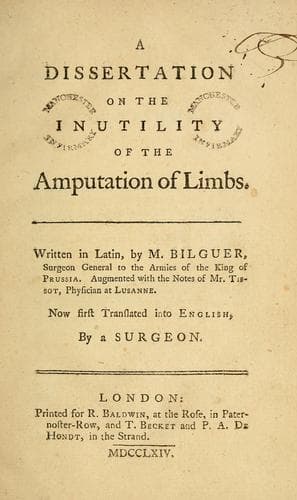
A dissertation on the inutility of the amputation of limbsBilguer, Johann Ulrich
History
A dissertation on the inutility of the amputation of limbs
Bilguer, Johann Ulrich
Amputation -- Early works to 1800
Further, if it be considered, that many of those who died, might
have recovered, had they been taken care of any where else than in an
hospital, where the air is very bad; and if it be called to mind at
the same time, what some very eminent surgeons have observed, that two
thirds of those die who have their limbs cut off[32], I hope it will
be readily acknowledged, that my method of treating wounded limbs, by
saving them, is highly preferable to that of amputation.
FOOTNOTES:
[27] _Halbe Invaliden._
[28] _Ganze Invaliden._
[29] _Schwerfracturirte._
[30] It is obvious that Mr. Bilguer has not made his calculations in so
favourable a manner for himself, as he might have done; I am persuaded
that in 6618 wounded men, a much greater number than 245 must have
died from the consequences of concussion, large flesh wounds, fevers,
fluxes, and other diseases, owing to a bad habit, bad air, the season
of the year, &c. TISSOT.
[31] Such a pretence would in effect be absurd: The reasoning would
amount to this; it is demonstrated that the danger arising from
amputation, joined to that attending wounds of themselves curable, has
killed a great many patients; therefore the danger arising from this
operation, joined to that attending wounds which have proved incurable,
would have saved a great many patients: Only the most blinded obstinacy
could reason in such a manner. TISSOT.
[32] See the memoirs of the Academy of Surgery, t. 2. p. 256. where Mr.
Boucher, in speaking of gunshot wounds, with the bone shattered near
the articulation, shews that amputation commonly proves fatal, and that
of three patients on whom it is performed, generally two die; whereas
out of an hundred and sixty-five who had had the bones shattered, on
whom amputation had not been performed, not one died. A degree of
success which he ascribes, it must be owned, to the management of the
surgeon; who, instead of spirituous applications, only made use of
emollients, light digestives and anodynes.
SECT. XXVIII.
Finally, I must add, that the greater number of those who died in our
hospitals, in consequence of wounded limbs, were of those who had the
os femoris shattered near its upper articulation; and as we are not
at present acquainted with any means of relieving that accident; and
as it has not as yet been attempted to amputate at that part, if we
deduct these cases from the number mentioned in the preceding section
who died, we shall see that the number of those whose lives were saved
without amputation, considerably exceeds that of those who died. Since
wounds near the superior part of the thigh bone, or shoulder, where the
bones are shattered, ought always to be looked on as desperate.
SECT. XXIX.
Public-domain text, read in full here on John Shaqi.
Reviews
Reviews
No reviews yet
Be the first to share your thoughts on this work.
Join the Discussion
Join the discussion
Sign in to leave a comment or review.
Sign InorCreate an account