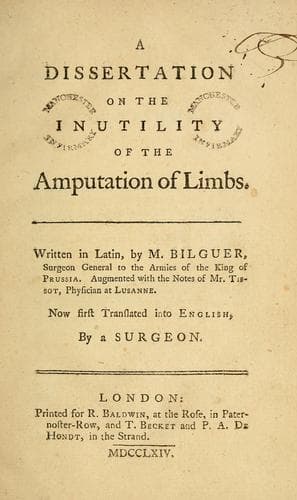
A dissertation on the inutility of the amputation of limbsBilguer, Johann Ulrich
History
A dissertation on the inutility of the amputation of limbs
Bilguer, Johann Ulrich
Amputation -- Early works to 1800
With respect to the os femoris, I do not know that any person hitherto
has attempted to amputate it at its upper extremity with success: The
arm has been successfully taken off at the shoulder, though but very
rarely[33]. Every body knows that the most able surgeons only allow of
the amputation of the thigh at its lower part, a little above the knee;
but even supposing it could be safely taken off in the middle, when the
bone is neither shattered, nor fissured higher up, the operation will
prove useless when it is done, as has so often been the case with our
wounded men.
The difficulty attending the amputation of the upper parts of the
thigh, is so considerable, that surgeons rather chuse to abandon
to their fate those wounded men where it appears necessary, than
to undertake it; and I own I am of the same opinion with them. If,
nevertheless, a case occured, wherein the death of the patient
appeared certain if amputation was not performed, and if the operation
could afford any hope, I would even prefer taking the limb off at
the articulation, rather than at any other place; for although it be
extremely difficult, it prevents, at least, the inconveniences and
accidents which a stump might occasion[34].
But as there can be no necessity for this operation, but in consequence
of the large arteries being wounded, by following the method I shall
point out § XXXV. it will be rendered unnecessary, and disputes
concerning it may be laid aside: For it is very certain, that the most
dangerous accidents even of this part, may be remedied, like those
in other parts, by joining to the method of treatment I have already
mentioned, the operation I shall describe § XXXV. providing it be
performed in time, before the patient be exhausted, and almost dying,
from the effects of the hurt being too long left to itself. But the
apprehension which patients have of the pain which deep incisions into
the fleshy parts would occasion, prevents extracting the pieces of
bone which compress or irritate the parts around; as also from cutting
through the membranes that are overstretched, and cause a constriction;
from giving a vent to impacted matter, and from conveying the medicines
to the parts where they ought to be applied. The consequence of all
this is, that the proper remedies are applied too late, and the
patient sinks under the pressure of the accident.
Public-domain text, read in full here on John Shaqi.
Reviews
Reviews
No reviews yet
Be the first to share your thoughts on this work.
Join the Discussion
Join the discussion
Sign in to leave a comment or review.
Sign InorCreate an account