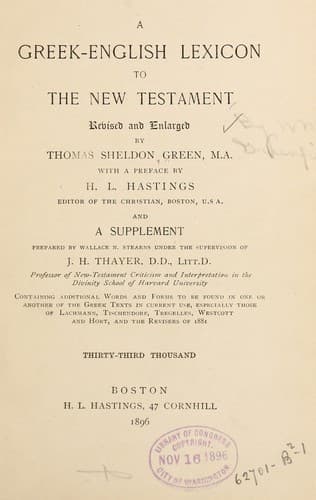
A Greek-English Lexicon to the New Testament — John Shaqi
A Greek-English Lexicon to the New TestamentGreenfield, William
Religion
A Greek-English Lexicon to the New Testament
Greenfield, William
Bible. New Testament -- Dictionaries -- English; Greek language, Biblical -- Dictionaries -- English
2 Co. 2.13; to dismiss, send away, Mar. 6.46; to renounce,
forsake, Lu. 14.33.
Ἀποτελέω, ῶ, (ἀπό & τελέω)
f. έσω, a.1. pass ἀπετελέσθην,
to complete; pass. to be perfected, to arrive at full stature or
measure, Ja. 1.15.
Ἀποτίθημι, (ἀπό & τίθημι)
f. θήσω, & mid. ἀποτίθεμαι, a.2. ἀπεθέμην,
to lay off, lay down or aside, as garments, Ac. 7.58; met. to lay
aside, put off, renounce, Ro. 13.12. Ep. 4.22, 25. Col. 3.8, et al.
Ἀποτινάσσω, (ἀπό & τινάσσω, to shake)
f. ξω,
to shake off, Lu. 9.5. Ac. 28.5.
Ἀποτίνω, (ἀπό & τίνω)
f. ίσω,
to pay off what is claimed or due; to repay, refund, make good,
Phile. 19.
Ἀποτολμάω, ῶ, (ἀπό & τολμάω)
f. ήσω,
to dare or risk outright; to speak without reserve or restraint,
Ro. 10.20.
Ἀποτομία, ας, ἡ, (ἀπότομος, cut off, shear, fr. ἀποτέμνω, to cut off,
fr. ἀπό & τέμνω)
pr. abruptness; met. unmitigated severity, rigour, Ro. 11.22. L.G.
Ἀποτόμως,
adv. sharply, severely, 2 Co. 13.10. Tit. 1.13.
Ἀποτρέπω, (ἀπό & τρέπω)
f. ψω,
to turn any one away from a thing; mid. to turn one's self away
from any one; to avoid, shun, 2 Ti. 3.5.
Ἀπουσία, ας, ἡ, (ἄπειμι)
absence, Phi. 2.12.
Ἀποφέρω, (ἀπό & φέρω)
f. ἀποίσω, a.1. ήνεγκα, a.2. ήνεγκον, a.1. pass. ηνέχθην,
to bear or carry away, conduct away, Mar. 15.1. Lu. 16.22.
1 Co. 16.3. Re. 17.3; 21.10.
Ἀποφεύγω, (ἀπό & φεύγω)
f. ξομαι, a.2. ἀπέφυγον,
to flee from, escape; met. to renounce, be free from.
2 Pe. 1.4; 2.18, 20.
Ἀποφθέγγομαι, (ἀπό & φθέγγομαι)
f. έγξομαι,
to speak out, declare, particularly solemn, weighty, or pithy
sayings, Ac. 2.4, 14; 26.25. L.G.
Ἀποφορτίζομαι, (ἀπό & φόρτος)
f. ίσομαι,
to unlade, Ac. 21.3. L.G.
Ἀπόχρησις, εως, ἡ, (ἀποχράομαι, to use up, consume by use)
a using, or a discharge of an intended use, Col. 2.22. L.G.
Ἀποχωρέω, ῳ (ἀπό & χωρέω)
f. ήσω,
to go from or away, depart, Mat. 7.23. Lu. 9.39. Ac. 13.13.
Ἀποχωρίζω, (ἀπό & χωρίζω)
f. ίσω, a.1. pass. ἀπεχωρίσθην,
to separate; pass. to be swept aside, Re. 6.14; to part, Ac. 15.39.
Ἀποψύχω, (ἀπό & ψύχω)
f. ξω,
pr. to breathe out, faint away, die; met. to faint at heart, be
dismayed, Lu. 21.26. (ῡ).
Ἀπρόσῐτος, ου, ὁ, ἡ, τό, -ον, (ἀ & προσιτός, accessible,
fr. πρόσειμι, to approach)
unapproached, unapproachable, 1 Ti. 6.16. L.G.
Ἀπρόσκοπος, ου, ὁ, ἡ, (ἀ & προσκοπή)
act. not causing to stumble; met. not causing others to stumble
in the path of duty, 1 Co. 10.32; pass. not stumbling, advancing
without stumbling; met. not obnoxious to moral exception, unblameble,
clear, Ac. 24.16. Phi. 1.10. N.T.
Ἀπροσωπολήπτως, (ἀ & προσωποληπτέω)
adv. without respect of persons, impartially, 1 Pe. 1.17. N.T.
Ἄπταιστος, ου, ὁ, ἡ, (ἀ & πταίω)
free from stumbling; met. free from offence and sin; irreprehensible,
Jude 24.
Ἅπτω,
f. ψω,
pr. to bring in contact, fit, fasten; to light, kindle;
mid. ἅπτομαι, f. ψομαι, a.1. ἡψάμην, to touch; to partake,
Col.
Public-domain text, read in full here on John Shaqi.
Reviews
Reviews
No reviews yet
Be the first to share your thoughts on this work.
Join the Discussion
Join the discussion
Sign in to leave a comment or review.
Sign InorCreate an account