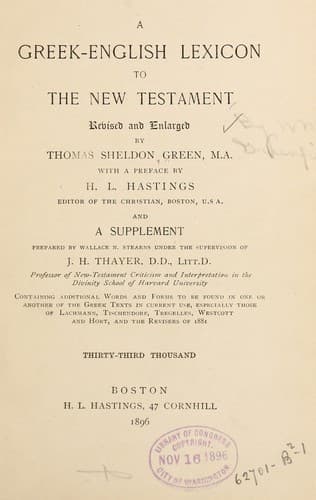
A Greek-English Lexicon to the New TestamentGreenfield, William
Religion
A Greek-English Lexicon to the New Testament
Greenfield, William
Bible. New Testament -- Dictionaries -- English; Greek language, Biblical -- Dictionaries -- English
2.21; to have intercourse with; to know carnally, 1 Co. 7.1;
by impl. to harm, 1 Jno. 5.18.
Ἀπωθέω, ῶ, (ἀπό & ὠθέω, to thrust)
f. ωθήσω & ώσω, & mid. ἀπωθέομαι, οῦμαι, a.1. ἀπωσάμην,
to thrust away, repel from one's self, repulse, Ac. 7.27; to refuse,
reject, cast off, Ac. 7.39; 13.46. Ro. 11.1, 2. 1 Ti. 1.19.
Ἀπώλεια, ας, ἡ, (ἀπόλλυμι)
consumption, destruction; waste, profusion, Mat. 26.8. Mar. 14.4;
destruction, state of being destroyed, Ac. 25.16; perdition, misery,
eternal ruin, Mat. 7.13. Ac. 8.20, et al.
Ἄρα
This particle denotes, first, transition from one thing to another
by natural sequence; secondly, logical inference; in which case the
premises are either expressed, Mat. 12.28, or to be variously
supplied. Therefore, then, consequently; should it so result.
Ac. 17.27.
Ἆρα,
a stronger form of the preceding, used in interrogations.
Ἀρά, ας, ἡ,
pr. a prayer; more commonly a prayer for evil; curse, cursing,
imprecation, Ro. 3.14.
Ἀργέω, ῶ
f. ήσω,
pr. to be unemployed; to be inoperative, linger, 2 Pe. 2.3:
from
Ἀργός, ή, όν, (ἀ & ἔργον) contr. fr. ἀεργός,
pr. inactive, unemployed, Mat. 20.3, 6; idle, averse from labour,
1 Ti. 5.13. Tit. 1.12; met. 2 Pe. 1.8; unprofitable, hollow, or
by impl. injurious, Mat. 12.36.
Ἀργύρεος, έα, εον, contr. οῦς, ᾶ, οῦν, (ἄργυρος)
made of silver, Ac. 19.24. 2 Ti. 2.20. Re. 9.20.
Ἀργύριον, ίου, τό, (fr. same)
silver; meton. money; spc. a piece of silver money, a shekel.
Ἀργυροκόπος, ου, ὁ, (same & κόπτω)
a forger of silver, silversmith, Ac. 19.24. L.G.
Ἄργῠρος, ου, ὁ,
silver; meton. any thing made of silver; money.
Ἄρειοπαγίτης,
a judge of the court of Areopagus. (ῑ).
Ἄρειος, ου, ὁ, ἡ, (Ἄρης, Mars)
of or belonging to Mars, Ac. 17.19, 22.
Ἀρεσκεία, ας, ἡ
a pleasing, desire of pleasing, Col. 1.10:
from
Ἀρέσκω,
f. ἀρέσω, imperf. ἤρεσκον, a.1. ἤρεσα,
to please; to be pleasing, acceptable; to consult the pleasure of:
whence
Ἀρεστός, ή, όν,
pleasing, acceptable, 1 Jno. 3.22; Jno. 8.29; Ac. 12.3; deemed
proper, Ac. 6.2.
Ἀρετή, ῆς, ἡ,
goodness, good quality of any kind; gracious dealing of God,
1 Pe. 2.9; 2 Pe. 1.3; virtue, uprightness, Phi. 4.8. 2 Pe. 1.5.
Ἀριθμέω, ῶ,
f. ήσω, a.1. ἠρίθμησα, p. pass. ἠρίθμημαι,
to number, Mat. 10.30. Lu. 12.7. Re. 7.9:
from
Ἀριθμός, οῦ, ὁ,
a number, Lu. 22.3. Jno. 6.10. Ac. 4.4. Re. 20.8; 13.18.
Ἀριστάω, ῶ (ἄριστον)
f. ήσω, a.1. ἠρίστησα,
to take the first meal, breakfast, Jno. 21.12, 15; also,
to take a midday meal, Lu. 11.37.
Ἀριστερός, ά, όν,
the left; ἀριστερά, sc. χείρ, the left hand, Mat. 6.3; so
ἐξ ἀριστερῶν sc. μερῶν, Lu. 23.33. 2 Co. 6.7.
Ἄριστον, ου, τό,
pr. the first meal, breakfast; afterwards extended to signify
also a slight midday meal, luncheon, Mat. 22.4.
Ἀρκετός, ή, όν,
sufficient, enough, Mat. 6.34; 10.25; 1 Pe. 4.3:
from
Ἀρκέω, ῶ,
f. ήσω, a.1. ἤρκεσα,
pr. to ward off; thence, to be of service, avail; to suffice,
Public-domain text, read in full here on John Shaqi.
Reviews
Reviews
No reviews yet
Be the first to share your thoughts on this work.
Join the Discussion
Join the discussion
Sign in to leave a comment or review.
Sign InorCreate an account