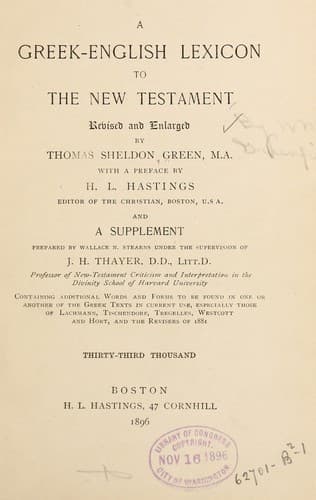
A Greek-English Lexicon to the New TestamentGreenfield, William
Religion
A Greek-English Lexicon to the New Testament
Greenfield, William
Bible. New Testament -- Dictionaries -- English; Greek language, Biblical -- Dictionaries -- English
be enough; pass. to be contented, satisfied, Lu. 3.14. 1 Ti. 6.8.
He. 13.5. 3 Jno. 10.
Ἄρκος,
v.r. for the following.
Ἄρκτος, ου, ὁ, ἡ,
a bear, Re. 13.2.
Ἅρμα, ατος, τό,
a chariot, vehicle, Ac. 8.28, 29, 38.
Ἁρμόζω,
f. όσω,
to fit together; mid. ἁρμόζομαι, a.1. ἡρμοσάμην, to join, unite,
in marriage, espouse, betroth, 2 Co. 11.2.
Ἁρμος, οῦ, ὁ,
a joint or articulation of the bones, He. 4.12.
Ἀρνέομαι, οῦμαι,
f. ήσομαι, p. ἤρνημαι, a.1. ἠρνησάμην,
to deny, contradict, affirm not to be; by impl. to reject, renounce,
disown; to be unwilling, refuse, He. 11.24.
Ἀρνίον, ου, τό,
a young lamb, lambkin, lamb, Jno. 21.15. Re. 5.6, 8.
Ἀρνός,
a gen. without a nom. in use, its place being supplied by ἀμνός,
a lamb.
Ἀροτριάω, ῶ,
f. άσω,
to plough, Lu. 17.7. 1 Co. 9.10:
from
Ἄροτρον, ου, τό (ἀρόω, to plough)
a plaugh, Lu. 9.62.
Ἁρπᾰγν, ῆς, ἡ (ἁρπάζω)
plunder, pillage, rapine; the act of plundering, He. 10.34; prey,
spoil, or, rapacity, Mat. 23.25. Lu. 11.39.
Ἁρπαγμός, οῦ, ὁ
rapine, robbery, thing plundered; met. & meton. what is retained
with an eager grasp, or eagerly claimed and conspicuously exercised,
Phi. 2.6:
from
Ἁρπάζω,
f. άσω & ξω, a.1. ἥρπασα, a.1. pass. ἡρπάσθην, a.2. pass. ἡρπάγην,
to seize, as a wild beast, Jno. 10.12; take away by force, snatch
away, Mat. 13.19. Jno. 10.28, 29. Ac. 23.10. Jude 23;
met. to seize on with avidity, claim, vindicate one's right,
Mat. 11.12; to convey away suddenly, transport hastily,
Jno. 6.15, et al.
Ἅρπαξ, ᾰγος, ὁ, ἡ, τό,
pr. ravenous, ravening, as a wild beast, Mat. 7.15;
met. rapacious, given to extortion and robbery, an extortioner,
Lu. 18.11. 1 Co. 5.10, 11; 6.10.
Ἀῤῥᾰβών, ῶνος, ὁ, (Hebrew, ערבון)
a pledge, earnest, 2 Co. 1.22; 5.5. Ep. 1.14.
Ἄῤῥᾰφος, ου, ὁ, ἡ, (ἀ & ῥάπτω, to sew)
not sewed, without seam, Jno. 19.23. N.T.
Ἅῤῥην, ἄῤῥεν, ενος, ὁ, τό,
male, of the male sex, Ro. 1.27. Re. 12.5, 13.
Ἄῤῥητος, ου, ὁ, ἡ, τό, -ον, (ἀ & ῥητός)
pr. not spoken; what ought not to be spoken, secret; which
cannot be spoken or uttered, ineffable, 2 Co. 12.4.
Ἄῤῥωστος, ου, ὁ, ἡ, (ἀ & ῥώννυμι)
infirm, sick, an invalid, Mat. 14.14. Mar. 6.5, 13; 16.18.
1 Co. 11.30.
Ἀρσενοκοίτης, ου, ὁ, (ἄρσην & κοίτη)
one who lies with a male, a sodomite, 1 Co. 6.9. 1 Ti. 1.10. L.G.
Ἄρσην, ἄρσεν, ενος, ὁ, τό,
male, of the male sex, Mat. 19.4. Mar. 10.6. Lu. 2.23. Ro. 1.27.
Gal. 3.28.
Ἄρτεμις, ιδος, ἡ,
Artemis or Diana, Ac. 19.24, 27, 28, 34.
Ἀρτέμων, ονος, ὁ, (ἀρτάω, to suspend)
a topsail, artemon, supparum; or, according to others, the dolon
of Pliny and Pollux, a small sail near the prow of the ship,
which was hoisted when the wind was too strong to use larger
sails, Ac. 27.40. N.T.
Ἄρτι
adv. of time, pr. at the present moment, close upon at either
before or after; now, at the present juncture, Mat. 3.15;
forthwith, presently, just now, recently, already,
1 Thes. 3.6; ἕως ἄρτι, until now, hitherto, Mat. 11.12.
Public-domain text, read in full here on John Shaqi.
Reviews
Reviews
No reviews yet
Be the first to share your thoughts on this work.
Join the Discussion
Join the discussion
Sign in to leave a comment or review.
Sign InorCreate an account