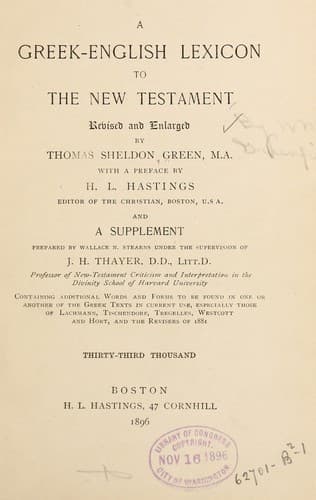
A Greek-English Lexicon to the New TestamentGreenfield, William
Religion
A Greek-English Lexicon to the New Testament
Greenfield, William
Bible. New Testament -- Dictionaries -- English; Greek language, Biblical -- Dictionaries -- English
Jno. 2.10, et al.; ἀπ' ἄρτι, v. ἀπάρτι, from this time,
henceforth, Mat. 23.39. et al.
Ἀρτιγέννητος, ου, ὁ, ἡ, (ἄρτι & γεννάω)
just born, new-born, 1 Pe. 2.2. L.G.
Ἄρτιος, ου, ὁ, ἡ, (ἄρω, to fit, adapt)
complete, perfect, 2 Ti. 3.17.
Ἄρτος, ου, ὁ,
bread; a loaf or thin cake of bread, Mat. 26.26, et al.;
food, Mat. 15.2. Mar. 3.20, et al.; support, maintenance,
living, necessaries of life, Mat. 6.11. Lu. 11.3. 2 Thes. 3.8.
Ἀρτύω, v. ἀρτύνω, (ἄρω, to fit)
f. ύσω, f. pass. ἀρτυθήσομαι, p. pass. ἤρτυμαι,
pr. to fit, prepare; to season, make savoury, Mar. 9.50.
Lu. 14.34. Col. 4.6.
Ἀρχάγγελος, ου, ὁ, (ἀρχι- & ἄγγελος)
an archangel, chief angel, 1 Thes. 4.16. Jude 9. N.T.
Ἀρχαῖος, αία, αῖον,
old, ancient, of a former age, Mat. 5.21, 27, 33, et al.:
from
Ἀρχή, ῆς, ἡ,
a beginning; in respect of time, beginning of things;
commencement of the gospel dispensation; of place, first
place or precedence in rank or power, sovereignty; one
invested with authority, a magistrate, potentate, prince;
an extremity, corner, Ac. 10.11. Τὴν ἀρχήν, used adverbially,
wholly, altogether, Jno. 8.25.
Ἀρχηγός, ου, ὁ, (ἀρχή & ἄγω)
a chief, leader, prince, sovereign, Ac. 5.31; author,
efficient cause, Ac. 3.15. He. 2.10; 12.2.
Ἀρχιερατικός, ή, όν,
pontifical, belonging to, or connected with the high priest
or his office, Ac. 4.6: (N.T.)
from
Ἀρχιερεύς, έως, ὁ, (ἀρχι- & ἱερεύς)
a high priest, chief priest.
Ἀρχιποίμην, ενος, ὁ, (ἀρχι- & ποιμήν)
chief shepherd, 1 Pe. 5.4 N.T.
Ἀρχισυναγώγος, ου, ὁ, (ἀρχι- & συναγωγή)
a president or moderating elder of a synagogue,
Mar. 5.22, 35, 36, 38. Lu. 8.49, et al. N.T.
Ἀρχιτέκτων, ονος, ὁ, (ἀρχι- & τέκτων)
architech, head or masterbuilder, 1 Co. 3.10
Ἀρχιτελώνης, ου, ὁ, (ἀρχι- & τελώνης)
a chief publican, chief collector of the customs or taxes,
Lu. 19.2. N.T.
Ἀρχιτρίκλῑνος, ου, ὁ, (ἀρχι- & τρίκλινος, triclinium, a dining-room
in which three couches were placed round the table, &c.)
director of a feast, Jno. 2.8, 9. N.T.
Ἄρχω,
f. ξω,
pr. to be first; to reign, govern; mid. to begin; to attempt;
to take commencement.
Ἄρχων, οντος, ὁ,
one invested with power and dignity, chief, ruler, prince,
magistrate, Mat. 9.23; 20.25, et al. freq.
Ἄρωμα, ατος, τό,
any aromatic substance, spice, &c. Mar. 16.1. Lu. 23.56; 24.1.
Jno. 19.40.
Ἀσάλευτος, ου, ὁ, ἡ, τό, -ον, (ἀ & σαλεύω)
unshaken, immoveable, Ac. 27.41; met. firm, stable, enduring,
He. 12.28.
Ἄσβεστος, ου, ὁ, ἡ, τό, -ον, (ἀ & σβέννυμι)
unquenched; inextinguishable; unquenchable, Mat. 3.12.
Mar. 9.43, 45. Lu. 3.17.
Ἀσέβεια, ας, ἡ, (ἀσεβής)
impiety, ungodliness; improbity, wickedness, Ro. 1.18; 11.26.
2 Ti. 2.16. Tit. 2.12. Jude 15, 18.
Ἀσεβέω, ῶ,
f. ήσω, p. ἠσέβηκα, a.1. ἠσέβησα,
to be impious, to act impiously or wickedly, live an impious
life, 2 Pe. 2.6. Jude 15:
from
Ἀσεβής, έος, οῦς, ὁ, ἡ, τό, -ές, (ἀ & σέβομαι)
impious, ungodly; wicked, sinful, Ro. 4.5; 5.6, et al.
Public-domain text, read in full here on John Shaqi.
Reviews
Reviews
No reviews yet
Be the first to share your thoughts on this work.
Join the Discussion
Join the discussion
Sign in to leave a comment or review.
Sign InorCreate an account