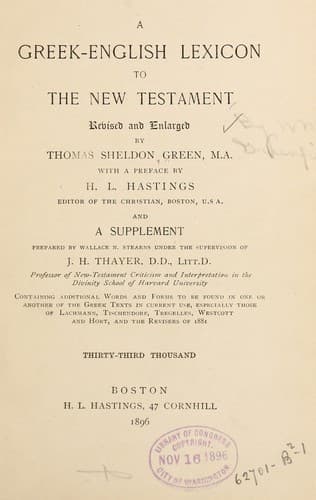
A Greek-English Lexicon to the New TestamentGreenfield, William
Religion
A Greek-English Lexicon to the New Testament
Greenfield, William
Bible. New Testament -- Dictionaries -- English; Greek language, Biblical -- Dictionaries -- English
Ἀσέλγεια, ας, ἡ, (ἀσέλγης, outrageous)
intemperance, licentiousness, lasciviousness, Ro. 13.13, et al.;
insolence, outrageous behaviour, Mar. 7.22.
Ἀσήμος, ου, ὁ, ἡ, (ἀ & σῆμα)
pr. not marked; met. not noted, not remarkable, unknown to fame,
ignoble, mean, inconsiderable, Ac. 21.39.
Ἀσθένεια, ας, ἡ, (ἀσθενής)
want of strength, weakness, feebleness, 1 Co. 15.43; bodily
infirmity, state of ill health, sickness, Mat. 8.17.
Lu. 5.15, et al.; met. infirmity, frailty, imperfection,
intellectual or moral, Ro. 6.19. 1 Co. 2.3. He. 5.2; 7.28;
by impl. suffering, affliction, distress, calamity,
Ro. 8.26, et al.
Ἀσθενέω, ῶ, (fr. same)
f. ήσω, a.1. ἠσθένησα,
to be weak, infirm, deficient in strength; to be inefficient,
Ro. 8.3. 2 Co. 13.3; to be sick, Mat. 25.36, et al.; met. to be
weak in faith, to doubt, hesitate, be unsettled, timid,
Ro. 14.1. 1 Co. 8.9, 11, 12. 2 Co. 11.29; to be deficient in
authroity, dignity, or power, be comtemptible, 2 Co. 11.21;
13.3, 9; by impl. to be afflicted, distressed, needy,
Ac. 20.35. 2 Co. 12.10; 13.4, 9:
whence
Ἀσθένημα, ατος, τό,
pr. weakness, infirmity; met. doubt, scruple, hesitation,
Ro. 15.1. N.T.
Ἀσθενής, έος, οῦς, ὁ, ἡ, τό, -ές, (ἀ & σθένος, strength)
without strength, weak, infirm, Mat. 26.41. Mar. 14.38.
1 Pe. 3.7; helpless, Ro. 5.6; imperfect, inefficient, Gal. 4.9;
feeble, without energy, 2 Co. 10.10; infirm in body, sick,
sickly, Mat. 25.39, 43, 44, et al.; weak, mentally or spiritually,
dubious, hesitating, 1 Co. 8.7, 10; 9.22. 1 Thes. 5.14;
by impl. afflicted, distressed, oppressed with calamities,
1 Co. 4.10.
Ἀσιανός, οῦ, ὁ, ἡ, (Ἀσία)
belonging to the Roman province of Asia, Ac. 20.4.
Ἀσιάρχης, ου, ὁ, (Ἀσία & ἀρχή)
an Asiarch, an officer in the province of Asia, as in other
eastern provinces of the Roman empire, selected, with others,
from the more opulent citizens, to preside over the things
pertaining to religious worship, and to exhibit annual public
games at their own expense in honour of the gods, in the manner
of the ædiles at Rome, Ac. 19.31. L.G.
Ἀσιτία, ας, ἡ,
abstinence from food, fasting, Ac. 27.21:
from
Ἄσῑτος, ου, ὁ, ἡ, (ἀ & σῖτος)
abstaining from food, fasting, Ac. 27.33.
Ἀσκέω, ῶ,
f. ήσω,
to exercise or exert one's self, endeavour, Ac. 24.16.
Ἀσκός, οῦ, ὁ,
a leathern bag or bottle, bottle of skin, Mat. 9.17.
Mar. 2.22. Lu. 5.37, 38.
Ἀσμένως,
adv. gladly, joyfully, Ac. 2.41; 21.17.
Ἄσοφος, ου, ὁ, ἡ, (ἀ & σοφός)
unwise; destitute of Christian wisdom, Ep. 5.15.
Ἀσπάζομαι,
f. σομαι, a.1. ἠσπασάμην, p. ἤσπασμαι,
to salute, greet, welcome, express one's good wishes, pay one's
respects, Mat. 10.12. Mar. 9.15, et al. freq.; to bid farewell,
Ac. 20.1; 21.6; to treat with affection, Mat. 5.47;
met. to embrace mentally, welcome to the heart or understanding,
He. 11.13:
whence
Ἀσπασμός, οῦ, ὁ,
salutation, greeting, Mat. 23.7. Mar. 12.38, et al.
Ἄσπῐλος, ου, ὁ, ἡ, (ἀ & σπίλος)
Public-domain text, read in full here on John Shaqi.
Reviews
Reviews
No reviews yet
Be the first to share your thoughts on this work.
Join the Discussion
Join the discussion
Sign in to leave a comment or review.
Sign InorCreate an account