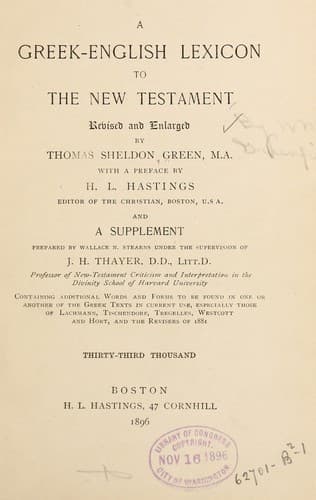
A Greek-English Lexicon to the New TestamentGreenfield, William
Religion
A Greek-English Lexicon to the New Testament
Greenfield, William
Bible. New Testament -- Dictionaries -- English; Greek language, Biblical -- Dictionaries -- English
spotless, unblemished, pure, 1 Ti. 6.14. Ja. 1.27. 1 Pe. 1.19.
2 Pe. 3.14. L.G.
Ἀσπίς, ίδος, ἡ,
an asp, a species of serpent of the most deadly venom, Ro. 3.13.
Ἄσπονδος, ου, ὁ, ἡ, (ἀ & σπονδή, a libation usually conjoined with
the making of a treaty)
pr. unwilling to make a tready; hence, implacable, irreconcilable,
Ro. 1.31. 2 Ti. 3.3.
Ἀσσάριον, ίου, τό,
dimin. of the Latin as a Roman brass coin of the value of
one-tenth of a denarious or δραχμή, and equal to 3 and one-tenth
farthings of our money, used to convey the idea of a very
trifling sum, Mat. 10.29. Lu. 12.6. N.T.
Ἆσσον,
adv. nearer; very nigh, close, Ac. 27.13; used as the comp. of ἄγχι.
Ἀστατέω, ῶ, (ἄστατος, unfixed, unstable, fr. ἀ & ἵστημι)
to be unsettled, have no fixed residence, wander about without
a home, 1 Co. 4.11. L.G.
Ἀστεῖος, ου, ὁ, ἡ, (ἄστυ, a city)
pr. belonging to a city; well-bred, polite, polished; hence,
elegant, fair, comely, beautiful, Ac. 7.20. He. 11.23.
Ἀστήρ, έρος, ὁ,
a star, liminous body like a star, liminary, Mat. 2.3, 7, 9, 10.
Re. 1.16, et al.
Ἀστήρικτος, ου, ὁ, ἡ, (ἀ & στηρίζω)
not made firm; unsettled, unstable, unsteady, 2 Pe. 2.14; 3.16. L.G.
Ἄστοργος, ου, ὁ, ἡ, (ἀ & στοργή, natural or instinctive affection)
devoid of natural or instinctive affection, without affection
to kindred, Ro. 1.31. 2 Ti. 3.3.
Ἀστοχέω, ῶ, (ἀ & στόχος, a mark)
f. ήσω, a.1. ἠστόχησα,
pr. to miss the mark; met. to err, deviate, swerve from,
1 Ti. 1.6, 21. 2 Ti. 2.18. L.G.
Ἀστρᾰπή, ῆς, ἡ,
lightning, Mat. 24.27; by impl. light, brightness, lustre, Lu. 11.36:
whence
Ἀστράπτω,
f. ψω,
to lighten, flash as lightning, Lu. 17.24; to be bright, shining,
Lu. 24.4.
Ἄστρον, ου, τό,
a constellation; a star, Lu. 21.25. Ac. 7.43; 27.20. He. 11.12.
Ἀσύμφωνος, ου, ὁ, ἡ, (ἀ & σύμφωνος)
discordant in sound; disagreeing, of a different opinion, Ac. 28.25.
Ἀσύνετος, ου, ὁ, ἡ, (ἀ & συνετός, fr. συνίημι)
without understanding, dull of apprehension, stupid, Mat. 15.16.
Mar. 7.18. Ro. 1.21; foolish, wicked, ungodly, corrupt,
Ro. 1.31; 10.19.
Ἀσυνθετος, ου, ὁ, ἡ, (ἀ & συντίθεμαι, to make a covenant)
a violator of covenants, covenant breaker, perfidious, Ro. 1.31.
Ἀσφάλεια, ας, ἡ,
pr. state of one who is secure from falling, firmness; safety,
security, 1 Thes. 5.3; certainty, truth, Lu. 1.4; diligence,
carefulness, vigilance, Ac. 5.23:
from
Ἀσφᾰλής, έος, οῦς, ὁ, ἡ, τό, -ές, (ἀ & σφάλλομαι, to stumble, fall)
pr. firm, secure from falling; firm, sure, steady, immoveable,
He. 6.19; met. certain, sure, Ac. 21.34; 22.30; 25.26; affording
means of security, making secure, Phi. 3.1:
whence
Ἀσφαλίζω,
f. ίσω,
to make fast, safe, or secure, Mat. 27.64--66. Ac. 16.24. L.G.
Ἀσφαλῶς,
adv. securely, safely; with care and diligence, Mar. 14.44.
Ac. 16.23; certainly, assuredly, Ac. 2.36.
Ἀσχημονέω, ῶ,
f. ήσω,
to be ἀσχήμων, indecorous, to behave in an unbecoming manner,
or indecorously, 1 Co.
Public-domain text, read in full here on John Shaqi.
Reviews
Reviews
No reviews yet
Be the first to share your thoughts on this work.
Join the Discussion
Join the discussion
Sign in to leave a comment or review.
Sign InorCreate an account