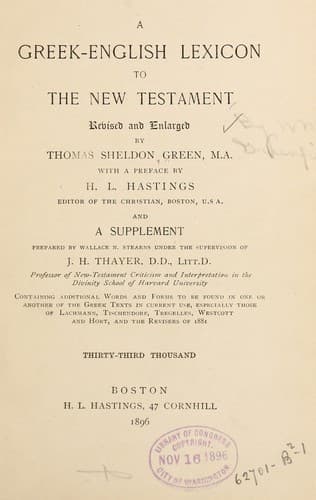
A Greek-English Lexicon to the New TestamentGreenfield, William
Religion
A Greek-English Lexicon to the New Testament
Greenfield, William
Bible. New Testament -- Dictionaries -- English; Greek language, Biblical -- Dictionaries -- English
13.5; to behave in a manner open to censure,
1 Co. 7.36.
Ἀσχημοσύνη, ης, ἡ
pr. external indecorum; nakedness, shame, pudenda, Re. 16.15;
indecency, infamous lust or lewdness, Ro. 1.27:
from
Ἀσχήμων, ονος, ὁ, ἡ, τό, -ον, (ἀ & σχήμα)
indecorous, uncomely, indecent, 1 Co. 12.23.
Ἀσωτία, ας, ἡ, (pr. the disposition and life of one who is ἀσωτος,
abandoned, recklessly debauched)
profligacy, dissoluteness, debauchery, Ep. 5.18. Tit. 1.6.
1 Pe. 4.4.
Ἀσώτως,
adv. dissolutely, profligately, Lu. 15.13.
Ἀτακτέω, ῶ,
f. ήσω,
pr. to desert one's ranks; met. to neglect one's duties,
behave disorderly, 2 Thes. 3.7:
from
Ἄτακτος, ου, ὁ, ἡ, (ἀ & τάσσω)
pr. spoken of soldiers who desert their ranks; met. neglectful
of duties, disorderly, 1 Thes. 5.14.
Ἀτάκτως,
adv. disorderly, 2 Thes. 3.6, 11.
Ἄτεκνος, ου, ὁ, ἡ, (ἀ & τέκνον)
childless, Lu. 20.28, 29, 30.
Ἀτενίζω, (ἀτενής, intent)
f. ίσω, a.1. ἠτένισα,
to fix one's eyes upon, to look steadily, gaze intently,
Lu. 4.20, et al.
Ἄτερ,
without, Lu. 22.6, 35.
Ἀτῑμάζω, (ἄτιμος)
f. άσω, a.1. ἠτίμασα, a.1. pass. ἠτιμάσθην,
to dishonour, treat with contumely or indignity,
Lu. 20.11. Jno. 8.49, et al.
Ἀτῑμία, ας, ἡ
dishonour, infamy, Ro. 1.26; indecorum, 1 Co. 11.14;
inaneness, vileness, Ro. 9.21. 1 Co. 15.43. 2 Ti. 2.20:
from
Ἄτῑμος, ου, ὁ, ἡ, (ἀ & τιμή)
unhonoured, without honour, exposed to contumelious
treatment, Mat. 13.57. Mar. 6.4. 1 Co. 4.10; 12.23.
Ἀτῑμόω, ῶ,
p. pass. ἠτίμωμαι,
to dishonour, treat with contumely, Mar. 12.4.
Ἀτμίς, ίδος, ἡ,
an exhalation, vapour, smoke, Ac. 2.19. Ja. 4.14.
Ἄτομος, ου, ὁ, ἡ, (ἀ & τέμνω)
indivisible, and by impl. exceedingly minute: ἐν ἀτόμῳ
sc. χρόνῳ, in an indivisible point of time, in an instant
or moment, 1 Co. 15.52.
Ἄτοπος, ου, ὁ, ἡ, (ἀ & τόπος)
pr. out of place; inopportune, unsuitable, absurd; new,
unusual, strange, in N.T., improper, amiss, wicked.
Lu. 23.41. 2 Thes. 3.2; noxious, harmful, Ac. 28.6.
Αὐγάζω,
f. άσω,
to shine upon, illuminate, irradiate, 2 Co. 4.4:
from
Αὐγή, ῆς, ἡ,
radiance; day-break, Ac. 20.11.
Αὐθάδης, εος, οῦς, ὁ, ἡ, (αὐτός & ἥδομαι)
one who pleases himself, wilful, obstinate; arrogant,
imperious, Ti. 1.7. 2 Pe. 2.10. (ᾱ).
Αὐθαίρετος, ου, ὁ, ἡ, (αὐτός & αἱρέομαι)
pr. one who chooses his own course of action; acting
spontaneously, of one's own accord, 2 Co. 8.3, 17.
Αὐθεντέω, ῶ, (to be αἰθέντης, one acting by his own authority
or power, contr. fr. αὐτοέντης, one who executes with
his own hand)
f. ήσω,
to have authority over, domineer, 1 Ti. 2.12. N.T.
Αὐλέω, ῶ, (αὐλός)
f. ήσω, a.1. ηὔλησα,
to play on a pipe or flute pipe, Mat. 11.17.
Lu. 7.32. 1 Co. 14.7.
Αὐλή, ῆς, ἡ,
pr. an unroofed enclosure; court-yard; sheepfold,
Jno. 10.1, 16; an exterior court, i.q. προαύλιον,
i.e. an enclosed place between the door and the
street, Re. 11.2; an interior court, quadrangle,
i.e.
Public-domain text, read in full here on John Shaqi.
Reviews
Reviews
No reviews yet
Be the first to share your thoughts on this work.
Join the Discussion
Join the discussion
Sign in to leave a comment or review.
Sign InorCreate an account