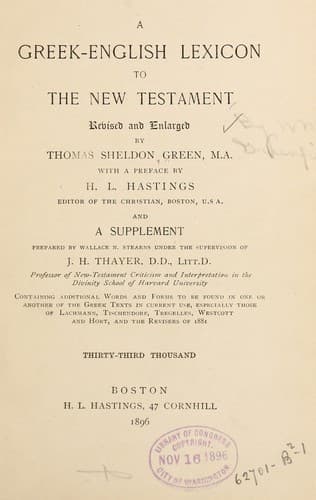
A Greek-English Lexicon to the New Testament — John Shaqi
A Greek-English Lexicon to the New TestamentGreenfield, William
Religion
A Greek-English Lexicon to the New Testament
Greenfield, William
Bible. New Testament -- Dictionaries -- English; Greek language, Biblical -- Dictionaries -- English
the open court in the middle of oriental houses,
which are commonly built in the form of a square
enclosing this court, Mat. 26.58, 69, et al.; by synecd.
a house, mansion, palace, Mat. 26.3. Lu. 11.21.
Αὐλητής, οῦ, ὁ, (αὐλέω)
a player on a pipe or flute, Mat. 9.23. Re. 18.22.
Αὐλίζομαι, (αὐλή)
f. ίσομαι, a.1. ηὐλίσθην,
pr. to pass the time in a court-yard; to lodge, bivouac;
hence, to pass the night in any place, to lodge at night,
pass or remain through the night, Mat. 21.17. Lu. 21.37.
Αὐλός, οῦ, ὁ,
a pipe or flute, 1 Co. 14.7.
Αὐξάνω, υ, αὔξω,
f. ήσω, a.1. ηὔξησα, a.1. pass. ηὐξήθην,
trans. to cause to grow or increase; pass. to be increased,
enlarged, Mat. 13.32. 1 Co. 3.6, 7, et al.; intrans. to
increase, grow, Mat. 6.28. Mar. 4.8, et al.:
whence
Αὔξησις, εως, ἡ
increase, growth, Ep. 4.16. Col. 2.19.
Αὔριον,
adv. to-morrow, Mat. 6.30, et al.; ἡ αὔριον sc. ἡμέρα,
the morrow, the next day, Mat. 6.34, et al.
Αὐστηρός, ά, όν
pr. harsh, sour in flavour; met. harsh, rigid, ungenerous,
Lu. 19.21, 22.
Αὐτάρκεια, ας, ἡ,
a competence of the necesssaries of life, 2 Co. 9.8;
a frame of mind viewing one's lot as sufficient,
contentedness, 1 Ti. 6.6:
from
Αὐτάρκης, εος, ους, ὁ, ἡ, (αὐτός & ἀρκέω)
pr. sufficient or adequate in one's self; contented
with one's lot, Phi. 4.11.
Αὐτοκατάκρῐτος, ου, ὁ, ἡ, (αὐτός & κατακρίνω)
self-condemned, Tit. 3.11. N.T.
Αὐτόμᾰτος, ου, ὁ, ἡ, (αὐτός & μέμαα, to be excited)
self-excited, acting spontaneously, spontaneous, of
his own accord, Mar. 4.8. Ac. 12.10.
Αὐτόπτης, ου, ὁ, ἡ, (αὐτός & ὄψομαι)
an eye-witness, Lu. 1.2.
Αὐτός, ή, ό,
a reflexive pron., self, very; alone, Mar. 6.31.
2 Co. 12.13; of one's self, of one's own motion,
Jno. 16.27; used also in the oblique cases
independently as a personal pron. of the third
person; ὁ αὐτός, the same; unchangeable, He. 1.12;
κατὰ τὸ αὐτό, at the same time, together, Ac. 14.1;
ἐπὶ τὸ αὐτό, in one and the same place, Mat. 22.34;
at the same time, together, Ac. 3.1. But for a full
account of the uses of αὐτός, see the Grammars.
Αὑτοῦ, ῆς, οῦ,
recip. pron. contr. fr. ἑαυτοῦ, ῆς, οῦ, himself,
herself, itself, Mat. 1.21, et al. freq.; for
σεαυτοῦ, ῆς, οῦ, thyself, Mat. 23.37.
Αὐτοῦ,
adv. of place. pr. in the very place; here, there,
in this, or that place, Mat. 26.36. Ac. 15.34; 18.19;
21.4.
Αὐτόχειρ, ρος, ὁ, ἡ, (αὐτός & χείρ)
acting or doing any thing with one's own hands,
Ac. 27.19.
Αὐχμηρός, ά, όν, (αὐχμέω, to be dry, squalid, filthy)
squalid, filthy; by impl. dark, obscure, murky,
2 Pe. 1.19.
Ἀφαιρέω, ῶ, (ἀπό & αἰρέω)
f. ήσω, a.2. ἀφεῖλον, a.1. pass. ἀφαιρεθήσομαι,
to take away, remove, Lu. 1.25; 10.42, et al.;
to take off, cut off, remove by cutting off,
Mat. 26.51. Mar. 14.47. Lu. 22.50.
Ἀφᾰνής, έος, οῦς, ὁ, ἡ, τό, -ές, (ἀ & φαίνω)
out of sight; not manifest, hidden, concealed, He. 4.13:
whence
Ἀφανίζω,
f. ίσω,
Public-domain text, read in full here on John Shaqi.
Reviews
Reviews
No reviews yet
Be the first to share your thoughts on this work.
Join the Discussion
Join the discussion
Sign in to leave a comment or review.
Sign InorCreate an account