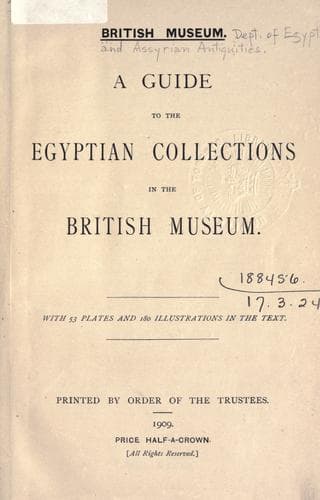
A guide to the Egyptian collections in the British MuseumBritish Museum. Department of Egyptian and Assyrian Antiquities
History
A guide to the Egyptian collections in the British Museum
British Museum. Department of Egyptian and Assyrian Antiquities
Egypt -- Antiquities
“Place in water, let stand for one night, strain through a cloth,
and smear over [the eye] for four days; or, according to another
prescription, paint it on [the eye] with a goose-feather.”[6]
The Egyptian physician was called upon not only to heal his patients, but
to beautify them, and we find prescriptions for removing scurf from the
skin, for changing the colour of the skin, for making the skin smooth,
and the following for removing wrinkles from the face:—
𓎡𓏏𓈖𓏏𓂧𓂋𓂡𓈎𓂋𓆑𓏲𓏼𓏌𓏤𓁷𓏤
“Another [prescription] for driving away wrinkles of the face.”
𓅮𓇌𓏏𓈒𓏼𓈖𓏏𓊹𓌣𓏏𓂋𓈒𓏼
Ball of incense 1
𓏠𓈖𓎛𓈒𓏼
Wax 1
𓆮𓏊𓏼𓇅𓆓𓏛
Fresh oil 1
𓎼𓇋𓏲𓆰𓏥
Cypress berries 1
[_Directions for use._]
𓏌𓂡𓏟𓏜𓂋𓂞𓁷𓏤𓎛𓋴𓐠𓄿𓈗𓏊𓏼𓂋𓂞𓂋𓁷𓏤𓇳𓏤𓏿𓁹𓌴𓁹𓄿𓄿𓎡
“Crush, and rub down and put in new milk and apply it to the face for
six days. Take good heed [to this].”[7]
The =population= of Egypt was, in 1897, 9,734,405 persons, of whom
8,978,775 were Muḥammadans, 25,200 Jews, and 730,162 Christians. The last
census was taken on the 29th April, 1907, and the entire population of
the country consisted of 11,272,000 persons, or nearly 16 per cent. more
than in 1897.
=The Egyptian Language= is not Semitic, although it possesses many
characteristics which resemble those of the Semitic languages, but in
a less developed form. Of all the views on the subject which have been
held in recent years, the most plausible one is that which makes Egyptian
belong to the group of Proto-Semitic languages. The Egyptian and the
Semitic languages appear to have sprung from a common stock, from which
they separated before their grammars and vocabularies were consolidated.
The Egyptian language developed rapidly under circumstances of which
nothing is known, and then, apparently, became crystallized; the Semitic
language developed less rapidly, but continued to develope for centuries
after the growth of the Egyptian language was arrested. To the period
when Egyptian separated itself from the parent stock no date can be
assigned, but it must have taken place some thousands of years before
Christ. Later, under the XVIIIth and XIXth dynasties, B.C. 1550 to 1300,
a large number of Semitic words were introduced into the language, and in
such compositions as the “Travels of an Egyptian” (see page 70) a great
many are transcribed into Egyptian characters.
The Egyptian language as known to us appears in four divisions, viz.:—
1. The Egyptian of the Early Empire, which was studied and employed for
literary purposes from about B.C. 4400 to about A.D. 200.
2. The Egyptian used in the ordinary business of life and for
conversation, from about B.C. 2600 to 650.
3. The popular speech of the country, from about 600 or 500 B.C. to the
end of the Roman Period.
Public-domain text, read in full here on John Shaqi.
Reviews
Reviews
No reviews yet
Be the first to share your thoughts on this work.
Join the Discussion
Join the discussion
Sign in to leave a comment or review.
Sign InorCreate an account