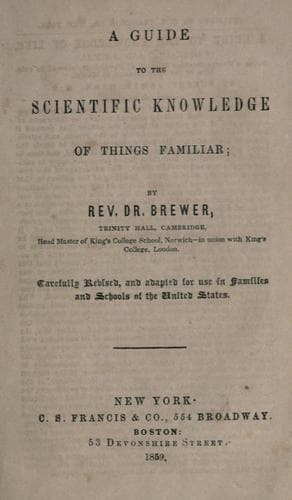
A Guide to the Scientific Knowledge of Things FamiliarBrewer, Ebenezer Cobham
Science
A Guide to the Scientific Knowledge of Things Familiar
Brewer, Ebenezer Cobham
Science -- Juvenile literature
Q. _Why does a JET of FLAME sometimes burst into the room THROUGH THE
BARS OF A STOVE?_
A. The iron bars conduct heat to the _interior of some lump of coal:_
and its volatile gas (bursting through the weakest part) is kindled by
the glowing coals over which it passes.
Q. _Why is this JET sometimes of a GREENISH YELLOW colour?_
A. When a lump of coals lies _over the hot bars_, or the coals below it
are not _red hot_, the gas which bursts from the lump _escapes unburnt_,
and is of a greenish colour.
Q. _Why does the gas escape UNBURNT?_
A. Because neither the _bars_ nor _coals_ (over which it passes) are
_red-hot_.
Q. _Why does a BLUISH FLAME sometimes flicker on the surface of hot
cinders?_
A. Gas from the hot coals _at the bottom of the grate_ mixing with the
_carbon of the coals above_, produces an inflammable gas (called
carbonic oxide), which burns with a blue flame.
Q. _Why is the FLAME of a good fire YELLOW?_
A. Because both the hydrogen and carbon of the fuel are in a state of
_perfect combustion_. It is the _white heat of the carbon_, which gives
the pale yellow tinge to the flaming hydrogen.
Q. _What is LIGHT?_
A. Rapid _undulations_ of a fluid called _ether_, striking on the eye.
Q. _How does COMBUSTION make these undulations of LIGHT?_
A. The atoms of matter (set in motion by heat) _striking against_ this
ether, produce _undulations_ in it; as a _stone_ thrown into a stream,
would produce undulations in the _water_.
Q. _How can UNDULATIONS of ether produce LIGHT?_
A. As _sound_ is produced by _undulations of air_ striking on the
_ear_; so _light_ is produced by undulations of _ether_ striking on the
_eye_.
Q. _What is ETHER?_
A. A very subtile fluid, which pervades and surrounds _every thing we
see_.
Q. _Mention a simple experiment to prove that LIGHT is produced by rapid
MOTION._
A. When a fiddle-string is _jerked_ suddenly, its rapid vibration
produces a grey _light_; and when a carriage wheel revolves very
quickly, it sends forth a similar light.
Q. _Does HEAT ALWAYS produce LIGHT?_
A. No: the heat of a stack of hay, or reeking dunghill, though very
_great_, is not sufficient to produce _light_.
Q. _Why is a YELLOW FLAME brighter than a RED HOT COAL?_
A. Because _yellow rays_ always produce the greatest amount of _light_;
though _red rays_ produce the greatest amount of _heat_.
Q. _Why is the LIGHT of a fire MORE INTENSE sometimes than at others?_
A. The _intensity_ of fire-light depends upon the _whiteness_ to which
the carbon is reduced, by combustion. If the carbon be _white hot_, its
_combustion is perfect_, and the light intense; if not, the light is
obscured by _smoke_.
Q. _Why will not CINDERS BLAZE, as well as FRESH coals?_
A. The _flame_ of coals is made chiefly by _hydrogen gas_. As soon as
this gas is consumed, the hot cinders produce only an _invisible_ gas,
called carbonic acid.
Q. _Where does the hydrogen gas of a fire come from?_
Public-domain text, read in full here on John Shaqi.
Reviews
Reviews
No reviews yet
Be the first to share your thoughts on this work.
Join the Discussion
Join the discussion
Sign in to leave a comment or review.
Sign InorCreate an account