A Guide to the Scientific Knowledge of Things Familiar — John Shaqi
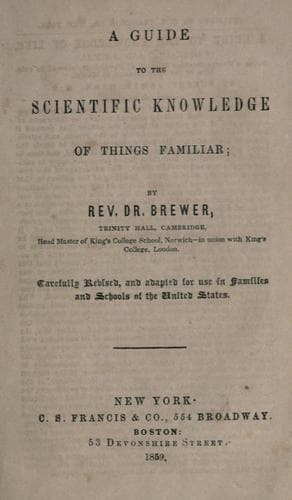
A Guide to the Scientific Knowledge of Things FamiliarBrewer, Ebenezer Cobham
Science
A Guide to the Scientific Knowledge of Things Familiar
Brewer, Ebenezer Cobham
Science -- Juvenile literature
A. The _fuel is decomposed_ (by combustion) into its simple elements,
carbon and hydrogen gas. (see p. 33)
Q. _Why does not a FIRE BLAZE on a FROSTY NIGHT, so long as it does upon
another night?_
A. The air (being very cold) _rushes to the fire so rapidly_, that the
coals burn out _faster_, and the inflammable gas _is sooner consumed_.
Q. _Why does a FIRE burn CLEAREST on a FROSTY night?_
A. Because the volatile gases are quickly consumed; and the solid
carbon _plentifully supplied with air_, to make it burn bright and
intensely.
Q. _Why does a FIRE burn more intensely in WINTER than in SUMMER time?_
A. Because the air is _colder_ in winter, than in summer-time.
Q. _How does the COLDNESS of the air increase the HEAT of a fire?_
A. For two reasons: 1st--Because cold air being more _condensed_ than
hot air, contains a greater _body_: and
2ndly--Cold air _rushes more quickly to the fire_, and supplies more
_oxygen_.
Q. _Why does the SUN, shining on a FIRE, make it DULL, and often put it
out?_
A. 1st--When the sun shines, the air is rarefied; and, therefore, _flows
more slowly to the fire_.
2ndly--As the air is _rarefied_, even that which _reaches_ the fire,
_affords less nourishment_.
Q. _Why does the air flow to the fire more TARDILY for being RAREFIED?_
A. The greater the _contrast_ (between the _external air_, and that
_which has been heated by the fire_) the more _rapid_ will be the
current of air towards that fire.
Q. _Why does rarefied air afford LESS NOURISHMENT to fire, than cold
air?_
A. Because it is _spread out_, (like a piece of gold _beaten into
leaf_); and as a square inch of gold _leaf_ will not contain so much
gold as a square inch of _bullion_--so, a square inch of _rarefied_ air
has less _body_, than a square inch of _cold air_.
Q. _Why does a FIRE burn more fiercely in the OPEN AIR?_
A. 1st--Because the _air out-of-doors_ is more _dense_, than the air
in-doors: and
2ndly--Because air is _more freely supplied_ to a fire out-of-doors.
Q. _Why is the air out-of-doors more DENSE than that in-doors?_
A. Because the circulation is more free; and as soon as any portion has
been _rarefied_, it instantly escapes, and is supplied by _colder
currents_.
Q. _Why does not a FIRE burn so freely in a THAW, as in a FROST?_
A. During a thaw, the air is filled with _vapour_; and, both _moves too
slowly_, and is _too much diluted_ to nourish the fire.
Q. _Why does a FIRE burn so fiercely in WINDY weather?_
A. In windy weather the _air is rapidly changed_, and affords plentiful
nourishment to the fire.
Q. _Why do a pair of BELLOWS get a fire up?_
A. A pair of bellows, (like the wind), _drives the air more rapidly to
the fire_; and the plentiful supply of oxygen soon makes the fire burn
intensely.
Q. _Why is a CANDLE BLOWN OUT by the breath, and not made more intense,
like a fire?_
Public-domain text, read in full here on John Shaqi.
Reviews
Reviews
No reviews yet
Be the first to share your thoughts on this work.
Join the Discussion
Join the discussion
Sign in to leave a comment or review.
Sign InorCreate an account