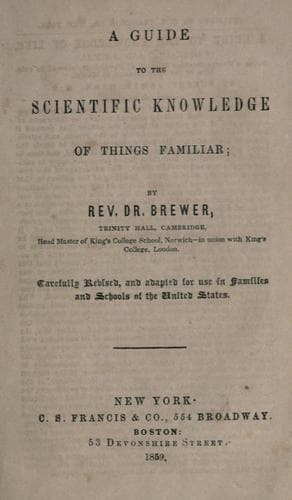
A Guide to the Scientific Knowledge of Things FamiliarBrewer, Ebenezer Cobham
Science
A Guide to the Scientific Knowledge of Things Familiar
Brewer, Ebenezer Cobham
Science -- Juvenile literature
A. As the flame of a candle is confined to a _very small wick_, it is
_severed_ from it by the breath; and (being unsupported) _must go out_.
Q. _Why is a SMOULDERING WICK sometimes REKINDLED by blowing it?_
A. The breath carries the air to it with _great rapidity_; and the
oxygen of the air kindles the _red hot wick_, as it kindles charred
wood.
Q. _Why is not the red hot wick kindled by the air AROUND it, without
BLOWING it?_
A. Because oxygen is not supplied with sufficient freedom, unless it be
_blown_ to the wick.
Q. _When is this experiment most likely to succeed?_
A. In _frosty_ weather; because the air contains more oxygen then,
_being condensed by the cold_.
Q. _Why does a POKER, LAID ACROSS a dull FIRE, revive it?_
A. For two reasons. 1st--Because the poker _concentrates the heat_, and
therefore increases it: and
2ndly--Because the poker _arrests the air_ which passes over the fire,
and _produces a draught_.
Q. _Why do SEVERAL PIECES of WOOD or coal burn BETTER than ONE?_
A. When there are two or three pieces of wood on a fire, the air
_(circulating round them) produces an eddy_ or draught, which draws up
the fire.
Q. _Why are STOVES fixed on the FLOOR of a room?_
A. In order that the air, _on the lower part of the room_, may be heated
by the fire.
Q. _Would not the air of the lower part of a room be heated equally
well, if the stoves were fixed higher up?_
A. No; the heat of a fire has a very little effect upon the air _below
the level of the grate_; and, therefore, every grate should be as _near
to the floor_ as possible.
Q. _Why are our FEET so COLD when we sit close by a good fire?_
A. As the fire consumes the air which passes over it, _cold air_ rushes
through the crevices of the doors and windows _along the bottom of the
room_ to supply the deficiency; and these currents of cold air, _rushing
constantly over our feet_, deprive them of their warmth.
Q. _If a piece of PAPER be laid FLAT on a clear fire, it will NOT BLAZE,
but CHAR. Why so?_
A. The carbon of a clear fire, being sufficiently hot to unite with the
oxygen of the air, _produces carbonic acid gas_, which soon envelops
the paper laid flat upon the cinders: but carbonic acid gas will not
_blaze_.
Q. _If you BLOW the paper, it will BLAZE immediately. Why so?_
A. By blowing, or opening the door suddenly, _the carbonic acid is
dissipated_, and the paper is instantly fanned into flame.
Q. _Why does WATER EXTINGUISH a FIRE?_
1st--Because the water _forms a coating_ over the fuel, and keeps it
from the air:
2ndly--The conversion of _water into steam_, draws off the _heat_ of the
burning fuel.
Q. _Why does a LITTLE WATER make a fire FIERCER, while a LARGER quantity
of water puts it OUT?_
A. Water is composed of _oxygen and hydrogen_; when, therefore, the fire
can decompose the water into its simple elements, it serves for _fuel_
to the flame.
Q. _How can WATER serve for FUEL to fire?_
Public-domain text, read in full here on John Shaqi.
Reviews
Reviews
No reviews yet
Be the first to share your thoughts on this work.
Join the Discussion
Join the discussion
Sign in to leave a comment or review.
Sign InorCreate an account