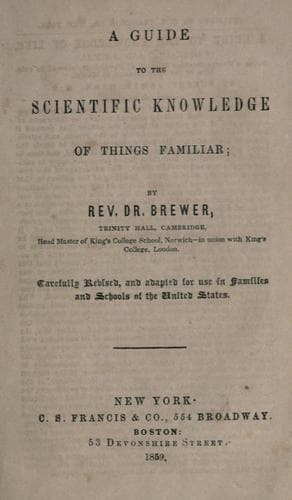
A Guide to the Scientific Knowledge of Things FamiliarBrewer, Ebenezer Cobham
Science
A Guide to the Scientific Knowledge of Things Familiar
Brewer, Ebenezer Cobham
Science -- Juvenile literature
Q. _Why does WATER SIMMER before it boils?_
A. The particles of water _near the bottom of the kettle_ (being formed
into _steam_ sooner than the rest) _shoot upwards_; but are _condensed_
again (as they rise) _by the colder water_, and produce what is called
"simmering."
Q. _What is meant by SIMMERING?_
A. A gentle tremor or _undulation_ on the surface of the water. When
water _simmers_, the bubbles _collapse beneath the surface_, and the
steam is condensed to _water again_: but when water _boils_, the bubbles
_rise to the surface_, and _steam is thrown off_.
Q. _Why does a KETTLE SING when the water simmers?_
A. Because the _air_ (entangled in the water) escapes by _fits and
starts_ through the _spout of the kettle_; which makes a noise like a
wind instrument, when it is blown into.
Q. _Why does NOT a kettle SING, when the water BOILS?_
A. As _all_ the water is _boiling hot_, the steam meets with no
_impediment_, but freely escapes in a continuous stream.
Q. _When does a kettle sing most?_
A. When it is set on a _hob_ to boil.
Q. _Why does a kettle SING MORE when it is set on the SIDE of a fire,
than when it is set in the MIDST of the fire?_
A. When the kettle is set on the _hob_ to boil, the heat is applied very
_partially: one side is hotter than the other_, and therefore the steam
is more _entangled_.
Q. _Why does a KETTLE sing, when the boiling water begins to COOL
again?_
A. Because the _upper_ surface cools _first_; and the steam (still
rising from the lower parts of the kettle) is _again entangled_, and
escapes fitfully.
Q. _Why does BOILING WATER SWELL?_
A. Water (like air) _expands by heat_. The heat of the fire drives the
particles of water _further apart from each other_; and (as they are not
_packed so closely together_) they take up _more room_; or (in other
words) the water _swells_.
Q. _What is meant when it is said, "that HEAT drives the PARTICLES of
water further APART from each other."_
A. Water is composed of little globules, like very small grains of sand;
the heat _drives_ these particles _away from each other_; and (as they
then require more _room_) the water _swells_.
Q. _Why does BOILING WATER BUBBLE?_
A. Water contains _air_; and (as the water is heated) _the air is driven
out_, and raises a _bubble_ in that part of the water which resists its
escape.
Q. _Why does a KETTLE sometimes BOIL OVER?_
A. Liquids _expand very much by heat_; if, therefore, a kettle be
_filled with cold water_, some of it must _run over_ as soon as it is
_expanded by heat_.
Q. _But I have seen a KETTLE BOIL OVER, although it has not been filled
FULL of WATER; how do you account for THAT?_
A. If a fire be _very fierce_, the air is expelled so _rapidly_, that
the _bubbles are very numerous_; and (towering one above the other)
_reach the top of the kettle, and fall over_.
Public-domain text, read in full here on John Shaqi.
Reviews
Reviews
No reviews yet
Be the first to share your thoughts on this work.
Join the Discussion
Join the discussion
Sign in to leave a comment or review.
Sign InorCreate an account