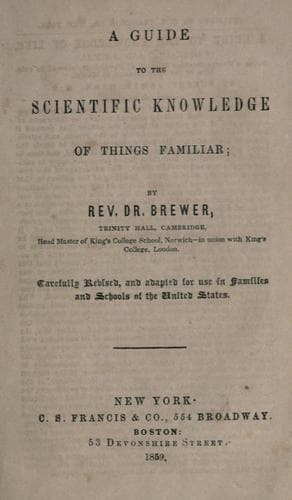
A Guide to the Scientific Knowledge of Things Familiar — John Shaqi
A Guide to the Scientific Knowledge of Things FamiliarBrewer, Ebenezer Cobham
Science
A Guide to the Scientific Knowledge of Things Familiar
Brewer, Ebenezer Cobham
Science -- Juvenile literature
Q. _How do you know that ELECTRICITY affects the motion of the clouds?_
A. Because clouds often meet from _opposite directions_; and (after they
have discharged their opposite electricities into each other) _vanish
altogether_.
Q. _Into how many CLASSES are the different sorts of CLOUDS generally
divided?_
A. Into three classes:--viz. Simple, Intermediate, and Compound.
Q. _How are SIMPLE CLOUDS sub-divided?_
A. 1.--Cirrus. 2.--Cum'ulus; and 3.--Stra'tus.
Q. _What are CIRRUS CLOUDS?_
A. Clouds like _fibres_, _loose hair_, or _thin streaks_, are called
cirrus clouds.
Q. _Why are these clouds called CIRRUS?_
A. From the Latin word, _cirrus_ ("a lock of hair, or curl"): they are
the most _elevated of all clouds_.
Q. _What do CIRRUS clouds PORTEND?_
A. When the streamers point _upwards_, the clouds are _falling_, and
_rain is at hand_: but when the streamers point _downwards_, expect
easterly wind or drought.
Q. _What are CUM'ULUS CLOUDS?_
A. Cum'ulus clouds are lumps like great _sugar-loaves_,--_volumes of
smoke_,--or _mountain towering over mountain_.
Q. _Why are these monster masses called_ CUM'ULUS CLOUDS?
A. From the Latin word, _cum'ulus_ (a mass or pile).
Q. _What do_ CUM'ULUS _clouds_ FORESHOW?
A. When these piles of cloud are _fleecy_, and sail _against the wind_,
they indicate _rain_; but when their outline is very _hard_, and they
come up _with the wind_, they foretell _fine weather_.
Cumulus clouds should be _smaller_ towards evening than they are at
noon. If they _increase_ in size at sun-set, a thunder-storm may be
expected in the night.
Q. _What are_ STRA'TUS CLOUDS?
A. Creeping mists, especially prevalent in a summer's evening: these
clouds rise at sun-set _in low damp places_, and are always _nearer the
earth_, than any _other_ sort of cloud.
Q. _Why are these mists called_ STRA'TUS _clouds?_
A. From the Latin word, _stra'tus_ ("laid low," or "that which lies
low").
Q. _How are the_ INTERMEDIATE CLOUDS _sub-divided?_
A. Into two sorts. 1.--The Cirro-Cum'ulus; and 2.--The Cirro-Stra'tus.
Q. _What are CIRRO-CUM'ULUS CLOUDS?_
A. When _cirrus_ clouds spring from a _massy centre_; or when _heavy
masses of cloud_ terminate at their edges in _long streaks_, or what are
called "_mares' tails_."
A system of small round clouds may be called cirro-cum'ulus.
Q. _What do CIRRO-CUM'ULUS clouds generally FOREBODE?_
A. Continued drought, or hot dry weather.
Q. _What are CIRRO-STRA'TUS CLOUDS?_
A. They compose what is generally called a "_mackarel sky_." This class
of clouds always indicate _rain and wind_; hence the proverb--
"Mackarels' scales and mares' tails
Make lofty ships to carry low sails."
Q. _How are COMPOUND CLOUDS sub-divided?_
A. Compound clouds are also sub-divided into two sorts. 1.--The
Cum'ulo-stra'tus; and 2.--The Nimbus.
Q. _What is meant by CUM'ULO-STRA'TUS clouds?_
Public-domain text, read in full here on John Shaqi.
Reviews
Reviews
No reviews yet
Be the first to share your thoughts on this work.
Join the Discussion
Join the discussion
Sign in to leave a comment or review.
Sign InorCreate an account