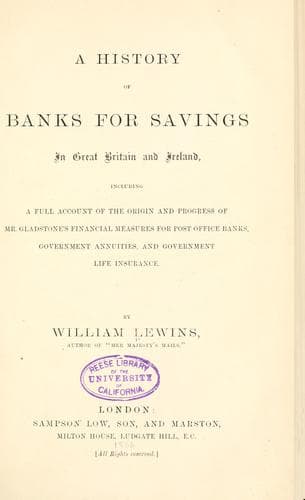
A History of Banks for Savings in Great Britain and IrelandLewins, William
History
A History of Banks for Savings in Great Britain and Ireland
Lewins, William
Postal savings banks -- Great Britain; Savings banks -- Great Britain
poor who deposited their savings; the extraordinary, those who paid to
an auxiliary fund an "annuity" of 5_s._, or a single donation of
2_l._; and honorary members were those who paid to the same fund an
"annuity" of 1_l._, or a single donation of 5_l._ The general business
of the society was transacted by a Court of Directors, consisting of a
Governor, five Directors, a Treasurer, and one or more Trustees, to be
chosen from the honorary and extraordinary members. The court acted
under the superintendence and control of a Standing Committee, which
consisted of fifteen persons chosen from the self-same kind of
members. Both these bodies were subordinate again to the General
Meeting, composed of all the members of the two courts mentioned, and
all the ordinary members of six months' standing. We scarcely think
there could be any possible necessity for such elaborate machinery. In
circumstances such as the rural population of Ruthwell, were cast, one
would have supposed that rules as little stringent as possible,
hampered with conditions as few as possible, would be needed, to
induce that population to save the trifles they could spare.
Inducements were held out to encourage and reward the frugal and
attentive; and so far admirable: but the system of fines inflicted
upon those who did not deposit a certain sum each year was a
questionable proviso. Mr. Duncan put the case very plausibly in his
_Essay_, where he said the chief defect of the scheme was, originally,
the want of some strong motive for regular payments; and, "as what we
have no pressing motive to do at a particular time we are apt to delay
till it is beyond our power to do it at all," he decided to fix a
small sum as penalty, should not a certain moderate amount be
deposited each year, a decision which we think was neither proper nor
wise. The regulations acted upon in the case of a proposed new member
were, we think, equally uncalled for, and likely to scare the
well-disposed away, rather than induce them to join. Before a person's
first deposit could be received, the elaborate machinery of management
commenced to make inquiries into the age, the family affairs, and
moral conduct of the proposed contributor, and according to the report
which followed, it was considered whether his deposits would be
admitted at all, or if admitted, what rate of interest it would be
proper to allow. The society lodged its money with the British Linen
Company, and got five per cent. interest for it. Four per cent. was
the usual interest allowed to depositors; to those, however, of three
years' standing whose deposits reached 5_l._, an indulgence of the
higher rate of 5 per cent. was made, provided the depositor wanted to
get married; in case of his having arrived at the age of fifty-six; to
his friends in case of his death; or, fourthly, in case the possession
of the money _should appear to the Court of Directors_, after due
inquiry, to be advantageous to the depositor or his family.[24] To put
Public-domain text, read in full here on John Shaqi.
Reviews
Reviews
No reviews yet
Be the first to share your thoughts on this work.
Join the Discussion
Join the discussion
Sign in to leave a comment or review.
Sign InorCreate an account