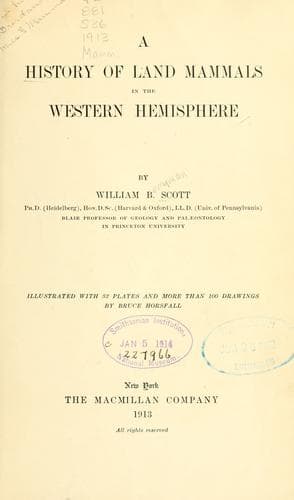
A history of land mammals in the western hemisphereScott, William Berryman
History
A history of land mammals in the western hemisphere
Scott, William Berryman
Mammals; Mammals, Fossil
In attempting to frame a definition of the term _Mammal_, it is
impossible to avoid technicalities altogether, for it is the complete
unity of plan and structure which justifies the inclusion of all the
many forms that differ so widely in habits and appearance. _Mammals are
air-breathing vertebrates, which are warm-blooded and have a 4-chambered
heart; the body cavity is divided into pleural and abdominal chambers
by a diaphragm; except in the lowest division of the class, the young
are brought forth alive and are always suckled, the milk glands being
universal throughout the class. In the great majority of mammals the
body is clothed with hair; a character found in no other animals. In
a few mammals the skin is naked, and in still fewer there is a partial
covering of scales._ The list of characters common to all mammals, which
distinguish them from other animals, might be indefinitely extended,
for it includes all the organs and tissues of the body, the skeletal,
muscular, digestive, nervous, circulatory, and reproductive systems, but
the two or three more obvious or significant features above selected will
suffice for the purposes of definition.
While the structural plan is the same throughout the entire class,
there is among mammals a wonderful variety of form, size, appearance,
and adaptation to special habits. It is as though a musician had taken
a single theme and developed it into endless variations, preserving
an unmistakable unity through all the changes. Most mammals are
_terrestrial_, living, that is to say, not only on the land, but on the
ground, and are herbivorous in habit, subsisting chiefly or exclusively
upon vegetable substances, but there are many departures from this mode
of life. It should be explained, however, that the term _terrestrial_ is
frequently used in a more comprehensive sense for all land mammals, as
distinguished from those that are aquatic or marine. Monkeys, Squirrels,
Sloths and Opossums are examples of the numerous _arboreal_ mammals,
whose structure is modified to fit them for living and sleeping in the
trees, and in some, such as the Sloths, the modification is carried so
far that the creature is almost helpless on the ground. Another mode of
existence is the burrowing or _fossorial_, the animal living partly or
mostly, or even entirely underground, a typical instance of which is the
Mole. The Beaver, Muskrat and Otter, to mention only a few forms, are
_aquatic_ and spend most of their life in fresh waters, though perfectly
able to move about on the land. _Marine_ mammals, such as the Seals and
Whales, have a greatly modified structure which adapts them to life in
the sea.
Public-domain text, read in full here on John Shaqi.
Reviews
Reviews
No reviews yet
Be the first to share your thoughts on this work.
Join the Discussion
Join the discussion
Sign in to leave a comment or review.
Sign InorCreate an account