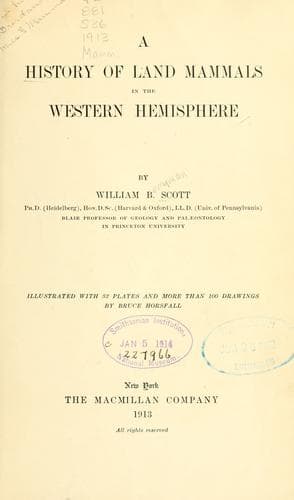
A history of land mammals in the western hemisphere — John Shaqi
A history of land mammals in the western hemisphereScott, William Berryman
History
A history of land mammals in the western hemisphere
Scott, William Berryman
Mammals; Mammals, Fossil
Within the limits of each of these categories we may note that there
are many degrees of specialization or adaptation to particular modes of
life. Thus, for example, among the marine mammals, the Whales and their
allies, Porpoises, etc., are so completely adapted to a life in the
seas that they cannot come upon the land, and even stranding is fatal
to them, while the Seals frequently land and move about upon the shore.
It should further be observed that mammals of the most diverse groups
are adapted to similar modes of existence. Thus in one natural group or
_order_ of related forms, occur terrestrial, burrowing, arboreal and
aquatic members, and the converse statement is of course equally true,
that animals of similar life-habits are not necessarily related to one
another, and very frequently, in fact, are not so related. Among the
typically marine mammals, for example, there are at least three and
probably four distinct series, which have independently become adapted to
life in the sea.
* * * * *
Before attempting to set forth an outline of what has been learned
regarding the history of mammalian life in the western hemisphere, it
is essential to give the reader some conception of the manner in which
that knowledge has been obtained. Without such an understanding of the
methods employed in the investigation the reader can only blindly accept
or as blindly reject what purports to be the logical inference from
well-established evidence. How is that evidence to be discovered? and how
may trustworthy conclusions be derived from it?
The first and most obvious step is to gather all possible information
concerning the mammals of the present day, their structure (comparative
anatomy), functions (physiology), and their geographical arrangement.
This latter domain, of the geographical distribution of mammals, is one
of peculiar significance. Not only do the animals of North America differ
radically from those of Central and South America, but within the limits
of each continent are more or less well-defined areas, the animals of
which differ in a subordinate degree from those of other areas. The study
of the modern world, however, would not of itself carry us very far
toward the goal of our inquiries, which is an _explanation_, not merely
a statement, of the facts. The present order of things is the outcome
of an illimitably long sequence of events and can be understood only in
proportion to our knowledge of the past. In other words, it is necessary
to treat the problems involved in our inquiry _historically_; to trace
the evolution of the different mammalian groups from their simpler
beginnings to the more complex and highly specialized modern forms; to
determine, so far as that may be done, the place of origin of each group
and to follow out their migrations from continent to continent.
Public-domain text, read in full here on John Shaqi.
Reviews
Reviews
No reviews yet
Be the first to share your thoughts on this work.
Join the Discussion
Join the discussion
Sign in to leave a comment or review.
Sign InorCreate an account