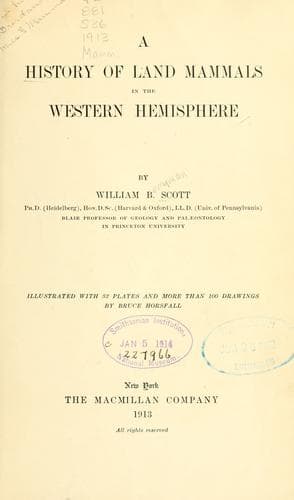
A history of land mammals in the western hemisphere — John Shaqi
A history of land mammals in the western hemisphereScott, William Berryman
History
A history of land mammals in the western hemisphere
Scott, William Berryman
Mammals; Mammals, Fossil
While we shall deal chiefly, almost exclusively, with the mammals of the
New World, something must be said regarding those of other continents,
for, as will be shown in the sequel, both North and South America have,
at one time or another, been connected with various land-masses of the
eastern hemisphere. By means of those land-connections, there has been
an interchange of mammals between the different continents, and each
great land-area of the recent world contains a more or less heterogeneous
assemblage of forms of very diverse places of origin. Indeed, migration
from one region to another has played a most important part in bringing
about the present distribution of living things. From what has already
been learned as to the past life of the various continents and their
shifting connections with one another, it is now feasible to analyze the
mammalian faunas of most of them and to separate the indigenous from the
immigrant elements. Among the latter may be distinguished those forms
which are the much modified descendants of ancient migrants from those
which arrived at a much later date and have undergone but little change.
To take a few examples from North America, it may be said that the Bears,
Moose, Caribou and Bison are late migrants from the Old World; that the
Virginia and Black-tailed Deer and the Prong-horned Antelope are of
Old World origin, but their ancestors came in at a far earlier period
and the modern species are greatly changed from the ancestral migrants.
The Armadillo of Texas and the Canada Porcupine are almost the only
survivors, north of Mexico, of the great migration of South American
mammals which once invaded the northern continent. On the other hand,
the raccoons and several families of rodents are instances of indigenous
types which may be traced through a long American ancestry.
Public-domain text, read in full here on John Shaqi.
Reviews
Reviews
No reviews yet
Be the first to share your thoughts on this work.
Join the Discussion
Join the discussion
Sign in to leave a comment or review.
Sign InorCreate an account