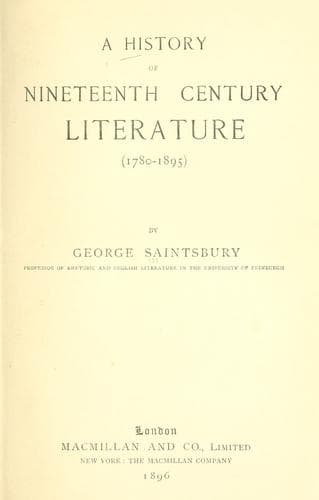
A History of Nineteenth Century Literature (1780-1895) — John Shaqi
A History of Nineteenth Century Literature (1780-1895)Saintsbury, George
History
A History of Nineteenth Century Literature (1780-1895)
Saintsbury, George
English literature -- 19th century -- History and criticism
It was in 1783--a date which, in its close approximation to the first
appearances of Crabbe and Cowper, makes the literary student think of
another group of first appearances in the early "eighties" of the
sixteenth century foreshadowing the outburst of Elizabethan
literature--that Blake's first book appeared. His _Poetical Sketches_,
now one of the rarest volumes of English poetry, was printed by
subscription among a literary coterie who met at the house of Mr. and
Mrs. Mathew; but the whole edition was given to the author. He had
avowedly taken little or no trouble to correct it, and the text is
nearly as corrupt as that of the _Supplices_; nor does it seem that he
took any trouble to make it "go off," nor that it did go off in any
appreciable manner. Yet if many ears had then been open to true poetical
music, some of them could not have mistaken sounds the like of which
had not, as has been said, been heard since the deaths of Herrick and
Vaughan. The merit of the contents is unequal to a degree not to be
accounted for by the mere neglect to prepare carefully for press, and
the influence of _Ossian_ is, as throughout Blake's work, much more
prominent for evil than for good. But the chaotic play of _Edward the
Third_ is not mere Elizabethan imitation; and at least half a dozen of
the songs and lyrical pieces are of the most exquisite quality--snatches
of Shakespeare or Fletcher as Shakespeare or Fletcher might have written
them in Blake's time. The finest of all no doubt is the magnificent "Mad
Song." But others--"How sweet I roamed from Field to Field" (the most
eighteenth century in manner, but showing how even that manner could be
strengthened and sweetened); "My Silks and Fine Array," beautiful, but
more like an Elizabethan imitation than most; "Memory Hither Come," a
piece of ineffable melody--these are things which at once showed Blake
to be free of the very first company of poets, to be a poet who for real
essence of poetry excelled everything the century had yet seen, and
everything, with the solitary exception of the _Lyrical Ballads_ at its
extreme end, that it was to see.
Public-domain text, read in full here on John Shaqi.
Reviews
Reviews
No reviews yet
Be the first to share your thoughts on this work.
Join the Discussion
Join the discussion
Sign in to leave a comment or review.
Sign InorCreate an account