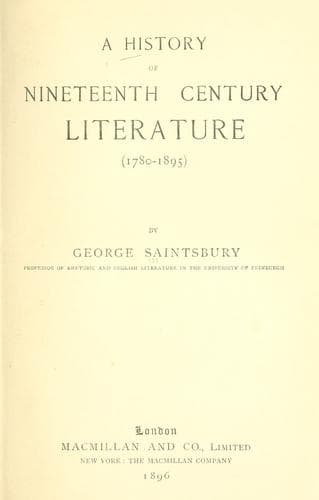
A History of Nineteenth Century Literature (1780-1895) — John Shaqi
A History of Nineteenth Century Literature (1780-1895)Saintsbury, George
History
A History of Nineteenth Century Literature (1780-1895)
Saintsbury, George
English literature -- 19th century -- History and criticism
Of the quartette, William Cowper was by far the oldest; the other three
being contemporaries within a few years. He was born on 26th November
1731 at Great Berkhampstead. His father was a clergyman and a royal
chaplain, his mother one of the Norfolk Donnes. Her early death, and
that school discomfort which afterwards found vent in _Tirocinium_,
appear to have aggravated a natural melancholia; though after leaving
Westminster, and during his normal studies at both branches of the law,
he seems to have been cheerful enough. How what should have been the
making of his fortune,--his appointment as Clerk of the Journals to the
House of Lords,--not unassisted by religious mania, drove him through
sheer nervousness to attempt suicide, is one of the best known things in
English literary biography, as indeed are most of the few events of his
sad life,--owing partly to his own charming letters, partly to the
biographies of Southey and others. His latest days were his unhappiest,
and after years of more or less complete loss of reason he died on 27th
April 1800.
It has been said that Cowper did not take to writing till late in life.
He had had literary friends--Churchill, Lloyd, and others--in youth, and
must always have had literary sympathies; but it was not till he was
nearly fifty, nor till the greater part of twenty years after his first
mental seizure, that he attempted composition at the instance of his
friend Newton and the Unwins. Beginning with hymns and trifles, he
before long undertook, at this or that person's suggestion, longer
poems, such as _Truth_, _The Progress of Error_, and _Expostulation_,
which were finished by 1781 and published next year, to be followed by
the still better and more famous _Task_, suggested to him by Lady
Austen. This appeared in 1785, and was very popular. He had already
begun to translate Homer, which occupied him for the greater part of
seven years. Nothing perhaps settled him more in the public affections
than "John Gilpin," the subject of which he also owed to Lady Austen;
and he continued to write occasional pieces of exquisite accomplishment.
Almost the last, if not actually the last, of these, written just before
the final obscuration of his faculties, was the beautiful and terrible
"Castaway," an avowed allegory of his own condition.
Public-domain text, read in full here on John Shaqi.
Reviews
Reviews
No reviews yet
Be the first to share your thoughts on this work.
Join the Discussion
Join the discussion
Sign in to leave a comment or review.
Sign InorCreate an account